Tài liệu Bộ 5 đề thi HK2 môn Tiếng Anh 12 có đáp án năm 2021 Trường THPT Kim Đồng được HOC247 biên soạn và tổng hợp giúp các em học sinh lớp 12 ôn tập kiến thức, rèn luyện chuẩn bị cho kì thi HK2 sắp tới cũng như giới thiệu đến quý thầy cô và các em học sinh tham khảo. Hi vọng tài liệu này sẽ có ích cho các em học sinh.
Mời các em học sinh và quý thầy cô cùng tham khảo.
|
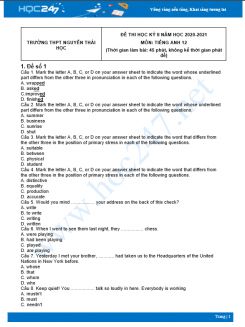
TRƯỜNG THPT KIM ĐỒNG |
ĐỀ THI HỌC KỲ II NĂM HỌC 2020-2021 MÔN: TIẾNG ANH 12 (Thời gian làm bài: 45 phút, không kể thời gian phát đề) |
1. Đề số 1
Read the following passage and mark the letter A, B, C, or D on your answer sheet to indicate the correct word or phrase that best fits each of the numbered blanks.
All living things require energy to do the work necessary for survival and reproduction. But what is energy? Energy is simply the ability to do work, (1) ......... work is done when a force moves an object. Let's consider your own needs for a moment. You need energy to turn on and turn off your computer. You need energy to (2).......... of bed in the morning. And, yes, you need energy to reproduce. So where does energy come from and how do we use it? On Earth, energy ultimately comes from the sun. Plants use the sun's energy to make sugar. Organisms, in turn, use sugar as a (3) ........... of energy to do work.
Plants use energy from sunlight to make sugar and oxygen from carbon dioxide and water. The process by which carbon dioxide and water are (4) .......... to sugar and oxygen using sunlight is referred to as photosynthesis. This is an endergonic reaction, meaning energy is required by the reaction. Specifically, energy is required to put the carbon dioxide and the water molecules together to form sugar. Sun (5).........the energy needed to drive photosynthesis, and some of the energy used to make the sugar is stored in the sugar molecule.
(study.com/energy-and-life-the–transformation-of-energy-in-living)
Question 1: A. why B. that C. where D. which
Question 3: A. get up B. wake out C. get out D. wake up
Question 3: A. source B. scale C. format D. degree
Question 4: A. purchased B. exchanged C. removed D. converted
Question 5: A. absorbs B. provides C. transfers D. consumes
Mark the letter A, B, C or D on your answer sheet to indicate the correct answer to each of the following questions.
Question 6: She started working as a teacher of English ten years ago.
A. She had worked with a teacher of English for ten years.
B. She has been working as a teacher of English for ten years.
C. She had been working as a teacher of English for ten years.
D. She has worked with a teacher of English for ten years.
Question 7: “Would you like to come to my birthday party, Mary?" said Mike.
A. Mike invited Mary to come to his birthday party.
B. Mike was told to come to Mary's birthday party.
C. Mike asked Mary if she didn't like to come to his birthday party.
D. Mike didn't know that Mary had come to his birthday party.
Mark the letter A, B, C, or D on your answer sheet to indicate the word that differs from the rest in the position of the main stress in each of the following questions.
Question 8: A. celebration B. traditional C. entertainment D. preparation
Question 9: A. figure B. double C. different D. support
Mark the letter A, B, C, or D to indicate the sentence that best combines each pair of sentences in the following questions.
Question 10: I felt quite sorry for Tom. I saw him cry at the time.
A. Have you ever felt sorry, seeing Tom cry?
B. Seeing Tom cry, I felt quite sorry for him.
C. I regret for having seen Tom cry that night.
D. I am sorry to tell you Tom was crying.
Question 11: I don't get high scores in English tests. I will be very annoyed.
A. I'm very annoyed because I don't get high scores in the tests.
B. It's the score in last English test that makes me very annoyed.
C. I'll be very annoyed unless I get good marks in English tests
D. I will be very annoyed for getting high scores in many tests.
Mark the letter A, B, C, or D on your answer sheet to show the underlined part that needs correction.
Question 12: Bella had better to change her study habits if she wants to be admitted to a good college.
A B C D
Question 13: Driving on the left made my daughter very surprising when she first visited London.
A B C D
Question 14: People consider it rude to point about anyone.
A B C D
Mark the letter A, B, C, or D on your answer sheet to indicate the word that is CLOSEST in meaning to the underlined word in each of the following questions.
Question 15: I received housing benefit when I was unemployed.
A. out of fashion B. out of date
C. out of order D. out of work
Question 16: The boy does not resemble his brother in any way.
A. take up B. look after
C. take after D. look up
Mark the letter A, B, C or D on your answer sheet to indicate the word or phrase that is OPPOSITE in meaning to the underlined part in each of the following questions.
Question 17: We need to build up people's awareness about the environment.
A. stabilize B. raise
C. decrease D. fluctuate
Question 18: Travel makes one modest, you see what a tiny place you occupy in.
A. lonely B. strong
C. shy D. self-confident
Mark the letter A, B, C or D on your answer sheet to indicate the most suitable response to complete each of the following exchanges.
Question 19: Helen: "Shall I collect the tickets for the concert for you.” – Peter: “......................”
A. Long time no see.
B. Nice to meet you hat.
C. Make yourself at home.
D. It's kind of you to do so.
Question 20: Jack: .................... - Rose: "That's a good idea."
A. Excuse me, where's the post office?
B. What about going to the cinema tonight?
C. Glad to see you.
D. Sorry, I'm late.
Mark the letter A, B, C or D on your answer sheet to indicate the correct answer to each of the following questions.
Question 21: You ....................... wash those apples. They have already been washed.
A. needn't B. need
C. must D. mustn't
Question 22: I enjoy playing ................. at weekends.
A. a badminton B. one badminton
C. the badminton D. badminton
Question 23: Our flight from Bangkok to London was delayed ................. the storm.
A. because of B. since
C. in spite of D. because
Question 24: The former Olympic .................. was invited to speak at a charity dinner.
A. champion B. victory
C. trophy D. triumph
Question 25: As soon as I saw the advertisement, I.................the house agent.
A. phone B. phoned
C. have phoned D. had phoned
Question 26: Suan is fond ................. reading comic books in her free time.
A. of B. for
C. on D. at
Question 27: If I were you. I ................. for that intensive English course.
A. will apply B. applied
C. would apply D. apply
Question 28: She was overjoyed because her article ......................
A. has been published
B. has published
C. had published
D. had been published
Question 29: She had no difficulty .................... at her new school.
A. making friends
B. make friends at her new school
C. to make friends
D. to making friends
Question 30: I really enjoy being with my father. He has got a really good ................... of humour.
A. feeling B. mood
C. way D. sense
Question 31: Neil Armstrong is the first man ........................ foot on the moon.
A. set B. to be set
C. to set D. setting
Choose the letter A, B, C or D to indicate the word whose underlined part is pronounced differently from that of the rest in each of the following questions.
Question 32: A. chemist B. church C. children D. change
Question 33: A. capable B. walking C. quality D. family
Read the following passage and mark the letter A, B, C or D on your answer sheet to indicate the correct answer to each of the questions.
I’m standing on a sidewalk in the early morning. The great avenues of Paris are silent, and the shops are closed. Suddenly, a couple appeared from a hole in the sidewalk. Mud covers their boots. They place the iron cover over the hole and run down the street, smiling. The couple had been exploring the tunnels beneath the city.
When Romans occupied Paris, they cut down stone from deep within the earth to build their city. Later, the French used more stone to construct the Notre Dame Cathedral. This left huge underground tunnels upon which part of the city now. Once used for growing mushrooms and as a hiding place, today they are mostly forgotten, except by "cataphiles" - those who love to go down into the tunnels below Paris, even though it is actually not permitted.
In the 70s and 80s, it is easier to enter the tunnels because there were many more open entrances through forgotten doorways and into catacombs - rooms filled with bones. The bones had been moved into the tunnels to solve the problem crowded cemeteries. By the end of the 1980s, most of the entrances were shut and police regularly walked the tunnels. However, there are still cataphiles, like the couple I saw that morning, and for those who dare, the underground is an exciting place to meet, party, perform for each
other or create art.
My own experience began beneath the old Paris opera house, where sewer workers showed me a 55-meter-long underground pond, a pond that actually had fish in it! Later, at France's national bank, officials guided me below to an amazing room filled with 2,600 tons of gold.
As cataphiles are the best guides, I then asked one of the cataphiles to give me a tour. Descending into the underground through a secret entrance beneath a bridge, we walked for hours through catacombs, and galleries of huge, bright paintings. The cataphile told me "Many people come down here to party, some to paint. Some people to destroy or to create or to explore. We do what we want, We don't have rules..."
(Adapted from Reading Explorer 2, Paul Macintyre&David Bohlke, 2015)
Question 34: What is the reading mainly about?
A. The tunnels under Paris and the people who explore them.
B. How the recent discovery of Paris's tunnels is changing the city.
C. Why tunnels will someday be Paris's newest tourist attraction.
D. Why tourists know so little about Paris's tunnels.
Question 35: The word "here" in paragraph 5 refers to ...................
A. the tunnels B. the opera house
C. the entrance D. the museum
Question 36: Which statement would a cataphile probably agree with?
A. Only cataphiles should be allowed to explore the tunnels.
B. People should be able to do whatever they want in the tunnels.
C. More police are needed to keep the tunnels safe.
D. The bones should be removed from the tunnels.
Question 37: Why was the couple that the writer met smiling as they ran down the street?
A. They had explored a tunnel without getting caught.
B. They had discovered a dangerous tunnel below.
C. They felt dirty and wanted to run home and take a shower.
D. They were able to replace the icon cover.
Question 38: Why did it use to be easier to enter the tunnels?
A. The tunnels were safer.
B. There were fewer dangerous people living there.
C. There was less water in the tunnels.
D. There were more open entrance.
Question 39: The word "descending" in paragraph 5 is closest in meaning to .................
A. going up B. going down
C. walking through D. coming across
Question 40: Which statement is NOT true about the tunnels under Paris?
A. Companies remove the stone to construct modern buildings.
B. There were once used as a hiding place.
C. People explore them even though it's not permitted.
D. People grew mushrooms there.
ĐÁP ÁN
|
Question 1 |
C |
Question 11 |
C |
Question 21 |
A |
Question 31 |
C |
|
Question 2 |
C |
Question 12 |
A |
Question 22 |
D |
Question 32 |
A |
|
Question 3 |
A |
Question 13 |
C |
Question 23 |
A |
Question 33 |
B |
|
Question 4 |
D |
Question 14 |
D |
Question 24 |
A |
Question 34 |
C |
|
Question 5 |
B |
Question 15 |
D |
Question 25 |
B |
Question 35 |
A |
|
Question 6 |
B |
Question 16 |
C |
Question 26 |
A |
Question 36 |
B |
|
Question 7 |
A |
Question 17 |
C |
Question 27 |
C |
Question 37 |
A |
|
Question 8 |
B |
Question 18 |
D |
Question 28 |
D |
Question 38 |
D |
|
Question 9 |
D |
Question 19 |
D |
Question 29 |
A |
Question 39 |
B |
|
Question 10 |
B |
Question 20 |
B |
Question 30 |
D |
Question 40 |
A |
2. Đề số 2
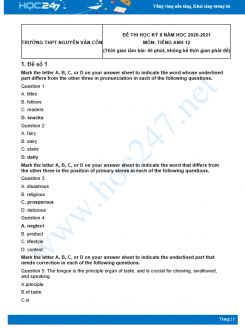
Mark the letter A, B, C, or D on your answer sheet to indicate the word whose underlined part differs from the other three in pronunciation in each of the following questions.
Question 1. A. design B. persuade C. pursue D. increase
Question 2. A. donate B. imitate C. operate D. private
Mark the letter A, B, C, or D on your answer sheet to indicate the word that differs from the other three in the position of primary stress in each of the following questions.
Question 3. A. rewarding B. fascinating C. tedious D. challenging
Question 4. A. compliment B. determine C. optimist D. marvelous
Mark the letter A, B, C, or D on your answer sheet to indicate the underlined part that needs correction in each of the following questions.
Question 5. By the end of the 21st century, scientists are discovering the cure for the common cold.
A. the end of B. 21st century
C. are discovering D. for
Question 6. The shopkeeper wanted the boys don’t lean their bicycles against his windows.
A. shopkeeper B. don’t
C. their D. against
Question 7. Although her friends tried to persuade her to apply for the job at a local factory, but Christine refused to make an application.
A. Although B. tried to persuade
C. to apply D. but
Mark the letter A, B, C, or D on your answer sheet to indicate the correct answer to each of the following questions.
Question 8. Have you had any news about that __ _ you applied for yet?
A. work B. job
C. career D. vacancy
Question 9. If my application is successful, I will be able to start work from 15th of August when I finish all my exams. I am ___ my CV with this letter.
A. mending B. attaching
C. closing D. enclosing
Question 10. Hellen usually ___ her childhood with great pleasure.
A. talks back to B. thinks back on
C. turns back to D. falls back on
Question 11. Many students ___ school to set up their own businesses and become self-employed.
A. move out of B. cut down on
C. drop out of D. drop in on
Question 12. By the time Ryan finally graduated from high school, he ___ five different schools because his parents move frequently.
A. attended B. was attending
C. had attended D. has been attending
Question 13. Some shops advertise their products and services in the newspaper to ___ customers.
A. encourage B. attract
C. interest D. promote
Question 14. Why were you acting ___ you hadn’t seen the boss?
A. the way B. as though C. like D. as
Question 15. Unless you ___ me about Sue’s new bob hair, I wouldn’t have noticed.
A. had told B. hadn’t told C. told D. didn’t tell
Question 16. ___ with passion for teaching help raise the test scores of their students.
A. Highly motivated tutor
B. Highly motivated tutors
C. Tutors are highly motivated
D. Being highly motivated tutors
Question 17. It seems that ___ my uncle travels abroad he forgets to take something he needs.
A. whenever B. by the time C. not until D. however
Question 18. Hayden spent ___ money buying food that he didn’t have enough left to buy a soft drink.
A. such a B. a lot C. too many D. so much
Question 19. A ___ described what he saw moments after the car bomb had exploded.
A. passer-by B. by-passer C. pass-by D. by-pass
Mark the letter A, B, C, or D on your answer sheet to indicate the most suitable response to complete each of the following exchanges.
Question 20. Lan: “Do you think your schooldays are the happiest days of your life? - Nam: “___________”
A. I believe schooldays last forever.
B. Were you happy during your schooldays?
C. I think so. We are worry-free and full of ambitions in the schooldays.
D. We didn’t have schooldays when we were at school.
Question 21. Hung: “How much do you earn in your new job?” - Xen: “ ______”
A. That’s a bit nosey of you.
B. You shouldn’t ask that.
C. I’m not your slave.
D. You can be so bossy at times!
Mark the letter A, B, C, or D on your answer sheet to indicate the word(s) CLOSEST in meaning to the underlined word(s) in each of the following questions.
Question 22. Lucy has just finished her A-levels and she has got a place at university, but she would really like a break from the academic world. Therefore, she decides to take a gap year and travel around the world.
A. a year off B. a year out
C. a year away D. a year’s trip
Question 23. Nowadays, lifelong learning is facilitated by e-learning platforms.
A. insisted B. assisted
C. assessed D. accessed
Mark the letter A, B, C, or D on your answer sheet to indicate the word(s) OPPOSITE in meaning to the underlined word(s) in each of the following questions.
Question 24. Thanks to lifelong learning, people’s level of awareness has improved significantly.
A. has increases B. has declined C. has gone up D. has bettered
Question 25. I’d go mad if I had to do a dead-end job like to working on a supermarket checkout.
A boring B. monotonous C. fascinating D. demanding
Mark the letter A, B, C, or D on your answer sheet to indicate the sentence that is closest in meaning to each of the following questions.
Question 26. “Why did you apply for the job?” her mother asked.
A. Her mother wanted to know the reason she applied for the job.
B. Her mother wanted to know the reason she had applied for the job.
C. Her mother wanted to know why did she apply for the job.
D. Her mother wanted to know why had she applied for the job.
Question 27. I am on the tenth page of the report I am writing.
A. I have completed writing ten pages of the report.
B. Tonight I’m going to write the tenth page of the report.
C. So far I have written ten pages of the report.
D. I have finished writing the report on the tenth page.
Question 28. I did far better than Chris in the exam.
A. Chris didn’t do as well as me in the exam. B. I did farther than Chris in the exam.
C. Chris did worse than me in the exam. D. I didn’t do worse than Chris had done.
Mark the letter A, B, C, or D on your answer sheet to indicate the sentence that best combines each pair of sentences in the following questions.
Question 29. I judge by the car he drives. I’d say he’s got a pretty good job.
A. Because I judge by the car he drives, I’d say he’s got a pretty good job.
B. When I judge by the car he drives, I’d say he’s got a pretty good job.
C. Unless I judge by the car he drives, I’d say he’s got a pretty good job.
D. Judging by the car he drives, I’d say he’s got a pretty good job.
Question 30. Matthew ran away from home. Matthew thought no one loved him.
A. Matthew ran away from home as when Matthew thought no one loved him.
B. Matthew ran away from home because Matthew thought no one loved him.
C. Thought that no one loved him, Matthew ran away from home.
D. Matthew thought no one loved him and so that Matthew ran away from home.
Read the following passage and mark the letter A, B, C, or D on your answer sheet to indicate the correct word or phrase that best fits each of the numbered blanks from 31 to 35.
If women choose to pursue a career once they have children, they often miss out on a close (31)_____ with their children. Helen Jamieson is a mother of three who has given (32)_____ work to look after her children full-time. She strongly believes that women are pressurized to do too much, driving themselves to the absolute limit. In her own case, after six years of paid employment, Helen finally decided to call it a day. She says she initially found it hard being at home, though she never misses the job itself. She admits that if she had had a brilliant career to begin (33)_____, she might feel differently now. Financially, she is no worse off (34)______ before, as the cost of childcare and commuting exceeded her actual income. (35)______ the government starts to give other tax incentives to working parents, she says she will not return to the workplace until her children are grown up.
Question 31. A. friendship B. relationship C. scholarship D. membership
Question 32. A. out B. in C. to D. up
Question 33. A. up B. with C. to D. at
Question 34. A. as B. so C. than D. then
Question 35. A. Unless B. If C. Provided D. Even if
Read the following passage and mark the letter A, B, C, or D on your answer sheet to indicate the correct answer to each of the questions from 36 to 40
In the exploration of the linguistic life cycle, it is apparent that it is much more difficult to learn a second language in adulthood than a first language in childhood. Most adults never completely master a foreign language, especially in phonology – hence the ubiquitous foreign accent. Their development often “fossilizes” into permanent error patterns that no teaching or correction can undo. Of course, there are great individual differences, which depend on effort, attitudes, amount of exposure, quality of teaching, and plain talent, but there seems to be a cap for the best adults in the best circumstances.
Many explanations have been advanced for children’s superiority: they exploit Motherese (the simplified, repetitive conversation between parents and children), make errors unselfconsciously, are more motivated to communicate, like to conform, are not set in their ways, and have no first language to interfere. But some of these accounts are unlikely, based on what is known about how language acquisition works. Recent evidence is calling these social and motivation explanations into doubt. Holding every other factor constant, a key factor stands out: sheer age.
Systematic evidence comes from the psychologist Elissa Newport and her colleagues. They tested Korean and Chinese-born students at the University of Illinois who had spent at least ten years in the United States. The immigrants were given a list of 276 simple English sentences, half of them containing some grammatical errors. The immigrants who came to the United States between the ages of 3 and 7 performed identically to American-born students. Those who arrived between the ages of 8 and 15 did worse the later they arrived, and those who arrived between 17 and 39 did the worst of all, and showed huge variability unrelated to the age of arrival.
Question 36. The passage mainly discusses _______.
A. adults differences in learning a foreign language
B. children’s ability to learn a language
C. the age factor in learning language fast
D. research into language acquisition
Question 37. From the passage, it can be inferred that “phonology” is the study of _______.
A. the grammar of a language
B. the rules of a language
C. the vocabulary of a language
D. the sound system of a language
Question 38. The word “cap” in the first paragraph is closest in meaning to _______.
A. prize B. limit
C. covering D. level
Question 39. According to the passage, young children learn language quickly for all of the following reasons EXCEPT _______.
A. they make many mistakes
B. they want to talk
C. their approach is flexible
D. they frequently repeat words
Question 40. In the experiment in the passage, the psychologists discovered that _______.
A. most students had lived in the U.S for more than 10 years
B. older students were unable to learn English
C. young students learned English best
D. students who arrived late were worst of all
ĐÁP ÁN
|
Question 1 |
A |
Question 11 |
C |
Question 21 |
B |
Question 31 |
B |
|
Question 2 |
D |
Question 12 |
C |
Question 22 |
A |
Question 32 |
D |
|
Question 3 |
A |
Question 13 |
B |
Question 23 |
B |
Question 33 |
B |
|
Question 4 |
B |
Question 14 |
B |
Question 24 |
B |
Question 34 |
C |
|
Question 5 |
C |
Question 15 |
A |
Question 25 |
C |
Question 35 |
A |
|
Question 6 |
B |
Question 16 |
B |
Question 26 |
B |
Question 36 |
C |
|
Question 7 |
D |
Question 17 |
A |
Question 27 |
C |
Question 37 |
D |
|
Question 8 |
D |
Question 18 |
D |
Question 28 |
A |
Question 38 |
B |
|
Question 9 |
D |
Question 19 |
A |
Question 29 |
D |
Question 39 |
A |
|
Question 10 |
B |
Question 20 |
C |
Question 30 |
B |
Question 40 |
C |
3. Đề số 3
Mark the letter A, B, C, or D on your answer sheet to indicate the sentence that best combines each pair of sentences in the following questions.
Question 1: It is raining cats and dogs outside. I want to climb the mountain today but I can’t.
A. I can’t carry out my mountain climbing because there are many cats and dogs falling out the sky.
B. It is the heavy rain that prevents me from climbing the mountain today.
C. I find it rather hard to climb the mountain despite a heavy downpour outside.
D. The heavy rain makes it possible for me to continue going climbing today.
Question 2: The most successful candidates are not always the best educated. They are the best trained in the technique.
A. The most successful candidates are the best at training in the technique, if not they will need education.
B. The most successful candidates are the people who are trained well in the technique, although well educated.
C. The most successful candidates are not always the best educated, but the best trained in the technique.
D. The most successful candidates are not only the best educated but also the best trained in the technique.
Mark the letter A, B, C or D on your answer sheet to indicate the correct answer to each of the following question.
Question 3: ______, he would have been able to pass the exam.
A. If he studied more B. Had he studied more
C. If he were studying to a greater degree D. Studying more
Question 4: You are old enough to take ______ for what you have done.
A. responsibility B. responsible C. responsibly D. irresponsible
Question 5: A new study group has been set ______ by the government.
A. out B. up C. away D. down
Question 6: We would rather Helen ______ us all the information we needed . We should have been well informed.
A. sent B. send C. had sent D. have sent
Question 7: Only because she had to support her family ______ to leave school.
A. that Alice decided B. so Alice decided C. Alice decided D. did Alice decide
Question 8: The majority of primary school teachers ______ women.
A. is B. are C. includes D. including
Question 9: After a ______ hesitation, she began to speak with such a convincing voice.
A. rude B. impolite C. small D. slight
Question 10: This is his fifth day on the tour. He ______ four countries.
A. has already visited B. already visited
C. visited D. is visiting
Question 11: ______ objective primary education is to provide students with basic knowledge of the country’s history, ______ geography and traditions.
A. 0/a B. The/the C. The/0 D. An/the
Question 12: Not all men are connected with ______ physical attractiveness of their girlfriends and wives.
A. a B. the C. an D. 0
Question 13: They always kept on good ______ with their next-door neighbors for the children’s sake.
A. terms B. will C. friendship D. relations
Question 14: They stayed for hours, ______ my mother was very annoyed about.
A. that B. which C. this D. whom
Question 15: Not until he was twenty five years old______ pursuit a scientific career.
A. he had B. has he C. he has D. did he
Question 16: Look! The yard is wet. It ______ last night.
A. couldn’t have rained B. must rain
C. must have rained D. should rain
Read the following passage and mark the letter A, B, C, or D on your answer sheet to indicate the correct answer to each of the questions.
People travel for a lot of reasons: Some tourists go to see battlefields or religious shrines. Others are looking for culture, or simply want to have their pictures taken in front of famous places. But most European tourists are looking for a sunny beach to lie on.
Northern Europeans are willing to pay a lot of money and put up with a lot of inconveniences for the sun because they have so little of it. Residents of cities like London, Copenhagen, and Amsterdam spend a tot of their winter in the dark because the days are so short, and much of the rest of the year in the rain. This is the reason why the Mediterranean has always attracted them. Every summer, more than 25 million people travel to Mediterranean resorts and beaches for their vacation. They all come for the same reason, sun!
The huge crowds mean lots of money for the economies of Mediterranean countries. Italy’s 30,000 hotels are booked solid every summer. And 13 million people camp out on French beaches, parks and roadsides. Spain’s long sandy coastline attracts more people than anywhere else. 37 million tourists visit yearly, or one tourist for every person living in Spain.
But there are signs that the area is getting more tourists than it can handle. The Mediterranean is already one of the most polluted seas on earth. And with increased tourism, it’s getting worse. The French can’t figure out what to do with all the garbage left by campers around St. Tropez. And in many places, swimming is dangerous because of pollution.
None of this, however, is spoiling anyone’s fun. The Mediterranean gets more popular every year with tourists. Obviously, they don’t go there for clean water and solitude. They tolerate traffic jams and seem to like crowded beaches. They don’t even mind the pollution. No matter how dirty the water is, the coastline still looks beautiful. And as long as the sun shines, it’s still better than sitting in the cold rain in Berlin, London, or Oslo.
Question 17: In paragraph 2, cities like London, Copenhagen, and Amsterdam are mentioned _______.
A. to prove that they have got more tourism than they handle.
B. to tell us how wealthy their people are.
C. to suggest that these cities lack places of historic interest and scenic beauty.
D. to show that they are not good cities in terms of geography and climate.
Question 18: According to the passage, which of the following factors might spoil the tourists’ fun at Mediterranean resorts and beaches?
A. Polluted water B. Traffic jams C. Rainy weather D. Crowded buses
Question 19: The writer seems to imply that Europeans travel mostly for the reason that ______.
A. they want to see historic remains or religious spots.
B. they would like to take pictures in front of famous sites.
C. they wish to escape from the cold, dark and rainy days back at home.
D. they are interested in different cultural traditions and social customs.
Question 20: The latter half of the last sentence in paragraph 3, “or one tourist for every person living in Spain” means _____.
A. every Spanish is visited by a tourist every year.
B. every person living in Spain has to take care of a tourist annually.
C. every year almost as many tourists visit Spain as there are people living in that country.
D. all the 37 million people living in Spain are tourists.
Question 21: The word “tolerate” in paragraph 5 is closest in meaning to ______.
A. reject B. endure C. exclude D. neglect
Question 22: The word “solid” in paragraph 3 means most nearly the same as ______.
A. having no spaces inside. B. seeming to be hard to book.
C. having less people than normal. D. being uncomfortable to live in.
Question 23: According to the passage, which of the following countries attracts more tourists than the others?
A. Greece B. France C. Spain D. Italy
Mark the letter A, B, C or D on your answer sheet to indicate the word that differs from the other three in the position of primary stress in each of the following questions.
|
Question 24: |
A. achievement |
B. calculate |
C. attitude |
D. voluntary |
|
Question 25: |
A. dictation |
B. communicate |
C. occasion |
D. reservation |
Mark the letter A, B, C or D on your answer sheet to indicate the word whose underlined part differs from the other three in pronunciation in each of the following questions.
|
Question 26: |
A. theme |
B. ethnic |
C. thunder |
D. honey-mouthed |
|
Question 27: |
A. levels |
B. requirements |
C. subject |
D. secondary |
Mark the letter A, B, C or D on your answer sheet to indicate the most suitable response to complete each of the following exchanges.
Question 28: The teacher asked students to discuss the situation “ Which is better, supermarkets and traditional markets”.
-Jennifer: “ I believe that supermarkets are much better than traditional markets”.
-Katherine: “______. Each has its own features”.
A. I can’t help thinking the same. B. I couldn’t agree with you more.
C. . I disagree with you. D. That’s completely true.
Question 29: Ann and Matthew are talking about the effects of global warming.
-Ann: “Does global warming worry you?”
-Matthew: “___________”
A. I can’t bear to think about it. B. What a shame!
C. I don’t like hot weather. D. Oh, it’s hotter and hotter.
Read the following passage and mark the letter A, B, C, or D on your answer sheet to indicate the correct answer to each of the questions.
People used to know more or less how their children would live. Now things are changing so quickly that they don’t even know what their own lives will be like in a few years’ time. What follows is not science fiction. It is how experts see the future.
You are daydreaming behind the steering wheel; is it too dangerous? No! That’s no problem because you have it on automatic pilot, and with its hi-tech computers and cameras, your car “know” how to get you home safe and sound.
What is for lunch? In the old days you used to stop off to buy a hamburger or a pizza. Now you use your diagnostic machine to find out which foods your body needs. If your body needs more vegetables and less fat, your food-preparation machine makes you a salad.
After lunch, you go down the hall to your home office. Here you have everything you need to do your work. Thanks to your information screen and your latest generation computer, you needn’t go to the office any more. The information screen shows an urgent message from a co-worker in Brazil. You can instantly send back a reply to him and go on to deal with other matters.
Question 30: What does “its” in line 5 refer to?
A. the future B. your home C. your car D. the steering wheel
Question 31: What of the following statement is true about life in the future?
A. People will go to work as they do today.
B. Hi-tech equipment will be out of the question.
C. It will be dangerous to drive cars because they are too fast.
D. People can have balanced diets for their meal.
Question 32: Which of the following is NOT true about life in the future?
A. Eating is a problem because food contains too much fat
B. There’s no need to concentrate much when driving.
C. Contacts between people are almost instant.
D. Getting information is a matter of just a few seconds.
Question 33: According to the passage, what do people use a diagnostic machine for?
A. To make food for them. B. To find out which foods their body needs
C. To provide them with food. D. To sell food for humans.
Question 34: Which “reply” CLOSET in meaning to?
A. replay B. request. C. answer D. question
Question 35: The word “urgent” in the last paragraph probably means _____.
A. expected B. pressing C. unnecessary D. hurry
Question 36: What is the main idea of the passage?
A. What life is like in the future.
B. The role of the computer in future life.
C. What foods people will eat in the future.
D. Life in the future will be the same as life at present.
Mark the letter A, B, C or D on your answer sheet to indicate the word(s) CLOSEST in meaning to the underlined word(s) in each of the following questions.
Question 37: Lucky will be like a dog with two tails if she gets into the team.
A. very proud B. very exhausted C. extremely pleased D. extremely dazed
Question 38: Some workers were inhibited from speaking by the presence of their managers.
A. deferred B. discharged C. triggered D. prevented
Mark the letter A, B, C or D on your answer sheet to indicate the word(s) OPPOSITE in meaning to the underlined word(s) in each of the following questions.
Question 39: But what the most prevents women from reaching the boardroom, say bosses and headhunters, is lack of hands-on experience of a firm’s core business.
A. unavailable B. untested C. impractical D. insignificant
Question 40: Nowadays, it was rather easy to buy a modern TV, and it does pack a punch to bring to life some really awesome visuals.
A. have little effect on something. B. make bad things happen.
C. prevent something from coming into use D. produce the results that aren’t intended
Mark the letter A, B, C or D on your answer sheet to indicate the sentence that is closest in meaning to each of the following questions.
Question 41: Maria says she’d like to have been put in a higher class.
A. Maria wishes she is put in a higher class.
B. Maria wishes she were put in a higher class.
C. Maria wishes she had been put in a higher class.
D. Maria wishes she will be put in a higher class.
Question 42: His parents made him study for his exams.
A. He was obliged to study for the exam by his parents.
B. He was made to study for the exam by his parents.
C. He is made to study for the exam by his parents.
D. He was made study for the exam by his parents.
Read the following passage and mark A, B, C, or D to indicate the correct answer to each of the blanks.
EXAM ADVICE
--(Nội dung đầy đủ, chi tiết vui lòng xem tại online hoặc đăng nhập để tải về máy)---
ĐÁP ÁN
|
1-B |
2-C |
3-B |
4-A |
5-B |
6-C |
7-D |
8-B |
9-D |
10-A |
|
11-C |
12-D |
13-A |
14-B |
15-D |
16-C |
17-D |
18-C |
19-C |
20-C |
|
21-B |
22-A |
23-C |
24-A |
25-D |
26-D |
27-A |
28-C |
29-A |
30-C |
|
31-D |
32-A |
33-B |
34-C |
35-D |
36-A |
37-C |
38-D |
39-C |
40-A |
|
41-C |
42-B |
43-B |
44-B |
45-A |
46-D |
47-C |
48-B |
49-D |
50-C |
GIẢI THÍCH CHI TIẾT
Question 1: Đáp án B
Thành ngữ: rain cats and dogs = rain heavily: mưa to.
Trời đang mưa rất to. Tôi muốn đi leo núi vào hôm nay nhưng không thể.
= B. Trời mưa to ngăn cản tôi đi leo núi vào hôm nay.
Cấu trúc: (to) prevent sbd from V-ing: ngăn cản ai làm gì.
Các đáp án còn lại không đúng nghĩa:
A. Tôi không thể tiến hành chuyến đi leo núi bởi vì có rất nhiều chó mèo từ trên trời rơi xuống.
C. Tôi cảm thấy khá khó để leo núi mặc dù có một trận mưa lớn ở bên ngoài.
D. Trời mưa to làm tôi có thể tiếp tục chuyến đi leo núi ngày hôm nay.
Question 2: Đáp án C
Những ứng cử viên thành công nhất không phải là những người được giáo dục tốt nhất. Họ được đào tạo tốt nhất trong ngành kĩ thuật này.
= C. Những ứng cử viên thành công nhất không phải luôn luôn là những người được giáo dục tốt nhất, nhưng họ được đào tạo tốt nhất trong ngành kĩ thuật này.
Các đáp án còn lại sai nghĩa:
A. Những ứng cử viên thành công nhất là người giỏi nhất trong khoản đào tạo ở ngành kĩ thuật này, nếu không thì họ sẽ cần đến giáo dục.
B. Những ứng cử viên thành công nhất là người được đào tạo tốt nhất ở ngành kĩ thuật này, mặc dù họ đã được giáo dục tốt.
D. Những ứng cử viên thành công nhất không chỉ được giáo dục tốt mà còn được đào tạo tốt nhất trong ngành kĩ thuật này.
Question 3: Đáp án B
Chủ điểm ngữ pháp liên quan đến Câu điều kiện loại 3.
Cấu trúc: If S had PII, S would have PII => Dạng đảo ngữ: Had S PII, S would have PII.
Diễn tả chỉ điều kiện không có thật trong quá khứ.
Dịch: Nếu anh ấy đã học hành chăm chỉ hơn thì anh ấy đã có thể vượt qua kì thi.
Question 4: Đáp án A
(to) take responsibility: chịu trách nhiệm.
Các đáp án còn lại:
B. responsible (adj): chịu trách nhiệm, có nghĩa vụ.
C. responsibly (adv): một cách có trách nhiệm, một cách đáng tin cậy.
D. irresponsible (adj): vô trách nhiệm.
Dịch: Bạn đủ tuổi để chịu trách nhiệm với những gì mình đã làm.
Question 5: Đáp án B
(to) set up = establish: thành lập.
Dịch: Một nhóm nghiên cứu mới đã được chính phủ thành lập.
Question 6: Đáp án C
Chủ điểm ngữ pháp liên quan tới Câu giả định.
Cấu trúc: S1 would rather (that) S2 had PII.
Diễn tả ý người thứ nhất muốn người thứ 2 làm gì đó trong Qúa khứ nhưng người thứ 2 đã không làm.
Dịch: Helen lẽ ra phải gửi cho chúng tôi tất cả những thông tin mà chúng tôi cần. Chúng tôi đáng nhẽ nên được thông báo 1 cách đầy đủ.
Chú ý: should have PII: đáng lẽ ra nên làm trong quá khứ nhưng đã không làm.
Question 7: Đáp án D
Thấy “Only” đứng đầu câu => Dấu hiệu của Đảo ngữ.
Đảo ngữ với “Only because”: Only because S V O + aux (Chỉ vì…)
Dịch: Chỉ vì phải trang trải cho gia đình mà Alice mới buộc phải đi đến quyết định thôi học.
Question 8: Đáp án B
The majority of the + plural noun + plural verb.
Dịch: Phần lớn giáo viên Tiểu học là phụ nữ.
Question 9: Đáp án D
Giải nghĩa: slight hesitation: Một chút do dự.
Trong các đáp án, chỉ có “slight” là đi với “hesitation” (collocation- từ đi với từ).
Các đáp án còn lại:
A. rude (adj): thô lỗ.
B. impolite (adj): bất lịch sự
C. small (adj): nhỏ.
Dịch: Sau một chút do dự, cô ấy đã bắt đầu lên tiếng với giọng điệu thuyết phục.
Question 10: Đáp án A
Thì Hiện tại hoàn thành diễn tả hành động vừa mới xảy ra gần đây, thường đi với trạng từ “already”, “just”, “yet”.
Dịch: Đây là ngày thứ 5 trong chuyến du lịch của anh ấy. Anh ấy đã tới thăm được 4 nước.
Question 11: Đáp án C
+“The objective primary education” mang tính cụ thể và được xác định bằng 1 cụm từ phía sau.
+“the country’s history, geography and traditions” đầy đủ là “the country’s history, the country’s geography and the country’s traditions” nhưng được viết gọn lại để tránh lặp từ.
Dịch: Mục tiêu giáo dục tiểu học là cung cấp cho học sinh những nền tảng kiến thức về lịch sử đất nước, địa lí và truyền thống.
Question 12: Đáp án D
Cụm danh từ: physical attractiveness: ngoại hình thu hút.
Dịch: Không phải tất cả đàn ông đều bị hấp dẫn bởi ngoại hình của vợ hay người yêu.
Question 13: Đáp án A
Cấu trúc: Tobe on good terms with: có mối quan hệ tốt với ai.
Dịch: Họ luôn luôn giữ mối quan hệ hòa hảo với những người hàng xóm vì lợi ích của bọn trẻ.
Question 14: Đáp án B
Đại từ quan hệ “which” đứng sau dấu phẩy dùng để thay thế cho cả mệnh đề đứng trước dấu phẩy.
Các đáp án còn lại:
A. that – Đại từ quan hệ (ĐTQH) thay thế cho danh từ chỉ người, vật hoặc cả cụm chỉ người và vật, đóng vai trò là chủ ngữ hoặc tân ngữ. “That” chỉ được dùng trong Mệnh đề quan hệ xác định và không bao giờ đứng sau dấu phẩy. Buộc phải dùng “That” trong trường hợp có bổ nghĩa chỉ sự so sánh nhất và tính tuyệt đối như The biggest…/The only/The last/The first, the second../etc.
C. this- Đại từ chỉ định, mang nghĩa “này, cái này”.
D. whom- thay thế cho danh từ chỉ người, đóng vai trò là tân ngữ.
Dịch: Họ ở lại hàng giờ đồng hồ, điều này khiến mẹ tôi rất tức giận.
Question 15: Đáp án D
“Not until” đứng đầu câu là dấu hiệu của Đảo ngữ.
Cấu trúc Đảo ngữ với “Not until”: Not until + (clause) + aux (Không cho tới khi….).
Dịch: Cho tới khi 25 tuổi thì anh ấy mới theo đuổi sự nghiệp khoa học.
Question 16: Đáp án C
Must have PII: chắc chắn đã (hành động chắc chắc đã xảy ra trong Qúa khứ do có dấu hiệu và bằng chứng rõ ràng ở hiện tại).
Các đáp án còn lại:
A. couldn’t have PII: có thể đã (hành động mang tính tiên đoán trong quá khứ, không có cơ sở rõ ràng).
B. must V-inf: chắc chắn (trong hiện tại)
C. should + V-inf: nên (mang hàm ý khuyên nhủ).
Dich: Nhìn kìa! Cái sân đang ướt. Chắc chắn tối qua trời đã mưa.
Question 17: Đáp án D
Ở đoạn 2, các thành phố như London, Copenhagen và Amsterdam được đề cập tới để _______.
A. chứng minh rằng họ có nhiều khách du lịch trên mức có thể kiểm soát.
B. nói với chúng ta rằng người dân ở đó giàu đến như thế nào.
C. gợi ý rằng những thành phố này đang thiếu những địa điểm lịch sử và các cảnh quan đẹp.
D. chỉ ra rằng đó không phải là những thành phố có vị trí địa lí và khí hậu thuận lợi.
Dịch câu: “Residents of cities like London, Copenhagen, and Amsterdam spend a tot of their winter in the dark because the days are so short, and much of the rest of the year in the rain” – (Người dân ở London, Copenhagen, và Amsterdam gần như là tận hưởng mùa đông trong tiết trời âm u bởi ban ngày rất ngắn và trời thì mưa quanh năm).
Question 18: Đáp án C
Theo như đoạn văn, yếu tố nào sau đây có thể làm mất hứng du khách trên các khu nghỉ mát và bãi biển ở Địa Trung Hải?
A. Ô nhiễm nước.
B. Tắc đường.
C. Mưa nhiều.
D. Xe bus đông đúc.
Dẫn chứng ở 3 câu cuối bài: “The Mediterranean gets more popular every year with tourists. Obviously, they don’t go there for clean water and solitude. They tolerate traffic jams and seem to like crowded beaches. They don’t even mind the pollution. No matter how dirty the water is, the coastline still looks beautiful. And as long as the sun shines, it’s still better than sitting in the cold rain in Berlin, London, or Oslo.” – (Biển Địa Trung Hải đang ngày càng hút khách qua mỗi năm. Rõ ràng rằng du khách tới đó không phải do nước sạch hay sự yên tĩnh. Họ chịu đựng tắc đường và trông còn có vẻ thích các bãi biển đông đúc. Họ thậm chí không bận tâm tới ô nhiễm. Dù nước có bẩn đục tới đâu thì trông các bờ biển vẫn rất tuyệt. Và miễn sao mặt trời có chiếu nắng xuống, vẫn tốt hơn là sống dưới những cơn mưa lạnh ở Berlin, London, hay Oslo”.
Question 19: Đáp án C
Nhà văn ám chỉ rằng người dân Châu Âu đi du lịch chủ yếu là do:
A. Họ muốn chiêm ngưỡng những di tích lịch sử và các điểm tôn giáo.
B. Họ muốn chụp ảnh trước những địa điểm nổi tiếng.
C. Họ muốn thoát khỏi những ngày lạnh lẽo, âm u và mưa nhiều ở quê nhà.
D. Họ quan tâm và thích thú các truyền thống văn hóa và những tập quán xã hội khác nhau.
Dẫn chứng ở đầu đoạn 2: “But most European tourists are looking for a sunny beach to lie on. Northern Europeans are willing to pay a lot of money and put up with a lot of inconveniences for the sun because they have so little of it. Residents of cities like London, Copenhagen, and Amsterdam spend a lot of their winter in the dark because the days are so short, and much of the rest of the year in the rain. This is the reason why the Mediterranean has always attracted them.” – (Hầu hết du khách Châu Âu mong mỏi được nghỉ dưỡng trên những bãi biển tràn ngập ánh nắng. Những người Bắc Âu thậm chí sẵn sàng chi mạnh tay và chịu đựng được những bất tiện do ánh nắng mang lại bởi họ đang rất thiếu thứ đó. Người dân ở London, Copenhagen, và Amsterdam gần như là tận hưởng mùa đông trong tiết trời âm u bởi ban ngày rất ngắn và trời thì mưa quanh năm. Đó là lí do mà biển Địa Trung Hải rất thu hút họ).
Question 20: Đáp án C
Nửa phần sau của câu cuối đoạn 3: “mỗi du khách đều tương đương với mỗi người dân sống ở Tây Ban Nha” có nghĩa là _______.
A. Mỗi năm, người dân Tây Ban Nha lại được 1 khách du lịch tới thăm.
B. Mỗi người dân Tây Ban Nha phải chăm sóc 1 khách du lịch vào hằng năm.
C. Hằng năm, gần như số khách du lịch tới Tây Ban Nha tương đương với số dân cư sống tại đây.
D. Có tất cả 37 triệu người sống ở Tây Ban Nha là khách du lịch.
Giải nghĩa: “Spain’s long sandy coastline attracts more people than anywhere else. 37 million tourists visit yearly, or one tourist for every person living in Spain.”– (Những bờ cát dài ở Tây Ban Nha thu hút nhiều khách du lịch hơn bất cứ nơi nào khác. Có 37 triệu du khách tới thăm hằng năm, hoặc có thể nói rằng mỗi du khách đều tương đương với mỗi người dân sống ở đây). => Hằng năm Tây Ban Nha tiếp đón 37 triệu du khách, số lượng này bằng với số dân cư ở Tây Ban Nha.
Question 21: Đáp án B
Câu hỏi từ vựng.
tolerate (v): chịu dựng, khoa dung = endure (v): cam chịu.
Các đáp án còn lại:
A. reject (v): từ chối, loại bỏ.
B. exclude (v): tống cổ, ngăn chặn, đuổi học.
D. neglect (v): sao lãng, thờ ơ.
Question 22: Đáp án A
Từ “solid” ở đoạn 3 gần nghĩa với _______.
A. không có khoảng rỗng bên trong.
B. trông có vẻ khó để đặt chỗ.
C. có ít người hơn thông thường.
D. không thoải mái để ở.
Solid (adj): đặc = A. không có khoảng rỗng bên trong.
Question 23: Đáp án C
Theo như đoạn văn, nước nào dưới đây thu hút nhiều khách du lịch hơn những nước còn lại?
A. Hy Lạp
B. Pháp
C. Tây Ban Nha
D. Ý
Dẫn chứng ở câu 3- đoạn 4: “Spain’s long sandy coastline attracts more people than anywhere else” – (Những bờ cát dài ở Tây Ban Nha thu hút nhiều khách du lịch hơn bất cứ nơi nào khác).
Question 24: Đáp án A
Trọng âm rơi vào âm tiết thứ 2, các đáp án còn lại rơi vào âm tiết thứ nhất.
A. achievement /əˈtʃiːv.mənt/ (n): thành tựu.
B. calculate /ˈkæl.kjə.leɪt/ (v): tính toán.
C. attitude /ˈæt.ɪ.tʃuːd/ (n): thái độ.
D. voluntary /ˈvɒl.ən.tər.i/ (adj): tự nguyện.
Question 25: Đáp án D
Trọng âm rơi vào âm tiết thứ 3, các đáp án còn lại rơi vào âm tiết thứ 2.
A. dictation /dɪkˈteɪ.ʃən/ (n): sự đọc chép, sự sai khiến.
B. communicate /kəˈmjuː.nɪ.keɪt/ (v): giao tiếp.
C. occasion /əˈkeɪ.ʒən/ (n): dịp, cơ hội.
D. reservation /ˌre.zəˈveɪ.ʃən/ (n): sự bảo tồn.
Lưu ý: Cách phát âm đuôi “s/es”
- Phát âm là /s/ khi từ có tận cùng bằng các phụ âm vô thanh: /ð/, /p/, /k/, /f/, /t/.
- Phát âm là /iz/ khi từ có tận cùng là các âm: /s/, /z/, /ʃ/, /tʃ/, /ʒ/, /dʒ/.
- Phát âm là /z/ khi các từ có tận cùng là nguyên âm và các phụ âm hữu thanh còn lại.
Question 26: Đáp án D
Phần gạch chân đáp án D được phát âm là /ð/, các đáp án còn lại đươc phát âm là /θ/.
A. theme /θiːm/ (n): chủ đề, nhạc hiệu.
B. ethnic /ˈeθ.nɪk/ (adj): thuộc về sắc tộc.
C. thunder /ˈθʌn.dər/ (n): sấm.
D.. honey-mouthed /hʌ.niˈmaʊðd/ (adj): nịnh lọt.
Question 27: Đáp án A
Phần gạch chân đáp án A được phát âm là /z/, các đáp án còn lại là /s/.
A. levels /ˈlev.əlz/ (n): cấp độ.
B. requirements /rɪˈkwaɪə.mənts/ (n): sự yêu cầu.
C. subject /ˈsʌb.dʒekt/ (n): chủ đề, môn học.
D. secondary /ˈsek.ən.dri/ (adj+n): thứ yếu, bậc trung học.
Question 28: Đáp án C
Giáo viên yêu cầu các học sinh thảo luận về tình huống: “ Cái nào tốt hơn, siêu thị hay chợ truyền thống?”.
-Jennifer: “Tớ tin rằng siêu thị ưu việt hơn chợ truyền thống”.
-Katherine: “______. Mỗi cái đều có điểm mạnh riêng của nó”.
A. Tớ cũng nghĩ vậy.
B. Tớ hoàn toàn đồng ý.
C. Tớ không đồng ý.
D. Điều đó hoàn toàn đúng.
Chỉ có đáp án C là phù hợp, Katherine đang phủ định ý kiến của Jennifer.
Question 29: Đáp án A
Ann và Matthew đang nói chuyện về tác động của sự nóng lên toàn cầu.
-Ann: “ Cậu có lo lắng về vấn đề nóng lên toàn cầu không?”.
-Matthew: “___________”
A. Tớ không thể ngừng việc nghĩ về nó.
B. Thật đáng hổ thẹn!
C. Tớ không thích trời nóng.
D. Ồ, thời tiết đang ngày càng nóng lên.
Chỉ có đáp án A là phù hợp, trả lời đúng trọng tâm câu hỏi.
Question 30: Đáp án C
Từ “nó” ở dòng 5 ám chỉ tới?
A. tương lai
B. ngôi nhà của bạn
C. xe của bạn
D. vô lăng
Để biết “its” ám chỉ cái gì ta đọc lại toàn bộ vế câu chứa nó: “That’s no problem because you have it on automatic pilot, and with its hi-tech computers and cameras, your car “know” how to get you home safe and sound” – “Đó không còn là vấn đề nữa bởi bạn đã có bộ điều khiển tự động, và với thiết bị máy tính và camera công nghệ cao, xe bạn sẽ biết đâu là cách để đưa bạn về nhà an toàn) => “its” chỉ có thể là ám chỉ tới “your car”
Question 31: Đáp án D
Câu nào dưới đây đúng về cuộc sống trong tương lại?
A. Con người sẽ đi làm như cách mà họ vẫn làm ngày nay.
B. Thiết bị công nghệ cao là bất khả thi.
C. Lái xe là rất nguy hiểm bởi chúng quá nhanh.
D. Con người đã có thể cân bằng chế độ dinh dưỡng trong bữa ăn của họ.
Dẫn chứng ở đoạn 2: “Now you use your diagnostic machine to find out which foods your body needs. If your body needs more vegetables and less fat, your food-preparation machine makes you a salad.” – (Bạn có thể sử dụng máy chuẩn đoán để nhận biết loại thực phẩm nào là cơ thể đang cần. Nếu cơ thể bạn đang cần nhiều rau xanh và ít chất béo, máy chuẩn bị thức ăn sẽ làm cho bạn món sa-lát). => Ý D đúng.
Question 32: Đáp án A
Ý nào sau đây không đúng về cuộc sống trong tương lai?
A. Ăn uống trở thành một vấn đề bởi thức ăn chứa quá nhiều chất béo.
B. Không cần phải dành nhiều sự tập trung trong lúc lái xe.
C. Liên lạc với nhau gần như là tức thời.
D. Nhận được thông tin chỉ trong vài giây.
Dẫn chứng từ câu 31 ta có thể suy ra: Trong tương lai, với sự xuất hiện của máy chuẩn đoán có thể giúp ta phát hiện loại thực phẩm mà cơ thể đang cần và máy chuẩn bị thức ăn sẽ làm ra những món có hàm lượng dinh dưỡng phù hợp với yêu cầu đó => Việc thực phẩm chứa quá nhiều chất béo sẽ không còn là vấn đề.
Ngoài ra, các ý còn lại cũng được tìm thấy trong bài:
B. Dẫn chứng ở câu cuối đoạn 1: “That’s no problem because you have it on automatic pilot, and with its hi-tech computers and cameras, your car “know” how to get you home safe and sound” – (Đó không còn là vấn đề nữa bởi bạn đã có bộ điều khiển tự động, và với thiết bị máy tính và camera công nghệ cao, xe bạn sẽ biết đâu là cách để đưa bạn về nhà an toàn).
C+D. Dẫn chứng ở đoạn cuối: “Thanks to your information screen and your latest generation computer, you needn’t go to the office any more. The information screen shows an urgent message from a co-worker in Brazil. You can instantly send back a reply to him and go on to deal with other matters.” – (Nhờ màn hình thông tin và máy tính thế hệ mới nhất , bạn không cần phải đi đến văn phòng nữa. Màn hình thông tin sẽ hiển thị tin nhắn khẩn từ một đồng nghiệp ở Brazin. Bạn ngay lập tức có thể gửi câu trả lời tới anh ta và tiếp tục giải quyết các vấn đề khác).
Question 33: Đáp án B
Theo như đoạn văn, con người sử dụng máy chuẩn đoán cho mục đích gì?
A. Để tạo ra thức ăn.
B. Để tìm ra loại thực phẩm mà cơ thể cần.
C. Để cung cấp thực phẩm.
D. Để bán thực phẩm.
Dẫn chứng ở đoạn 2: “Now you use your diagnostic machine to find out which foods your body needs”- (Bạn có thể sử dụng máy chuẩn đoán để nhận biết loại thực phẩm nào là cơ thể đang cần).
Question 34: Đáp án C
Câu hỏi từ vựng.
reply (v): đáp lại, hồi âm = answer (v+n): trả lời.
Các đáp án còn lại:
A. replay (v): chơi lại (thể thao), phát lại,…
B. request (v): thỉnh cầu, yêu cầu.
D. question (n+v): hỏi, câu hỏi.
Dịch: Bạn ngay lập tức có thể hồi âm lại anh ta và tiếp tục giải quyết các vấn đề khác
Question 35: Đáp án D
Câu hỏi từ vựng.
urgent (adj): khẩn cấp = pressing (adj): cấp bách, cấp thiết.
Các đáp án còn lại.
A. expected (Ved+adj): mong chờ, đáng mong đợi.
C. unnecessary (adj): không cần thiết.
D. hurry (adj): hối hả, gấp rút.
Dịch: Màn hình thông tin sẽ hiển thị tin nhắn khẩn từ một đồng nghiệp ở Brazin
Question 36: Đáp án A
Đâu là ý chính của đoạn văn?
A. Cuộc sống sẽ như thế nào trong tương lai.
B. Vai tròn của máy tính trong tương lai.
C. Loại thực phẩm nào mà con người sẽ tiêu thụ trong tương lai.
D. Cuộc sống trong tương lao sẽ giống với cuộc sống hiện tại.
Sau khi làm những câu hỏi trên có thể dễ dàng suy ra được ý chính của bài là: Cuộc sống trong tương lại. Từ đoạn đầu tiên, câu chủ đề là: “What follows is not science fiction. It is how experts see the future” – (Những điều sau đây không phải là khoa học viễn tưởng. Đó là cách mà các chuyên gia nhìn thấy tương lai). Sau đó xuyên suốt toàn bài là những ý tưởng có thể phổ biến trong cuộc sống tương lai như: xe không người lái, máy chuẩn bị thức ăn, máy tính công nghệ cao.
Question 37: Đáp án C
Thành ngữ: like a dog with two tails vô cùng hạnh phúc = extremely pleased.
Các đáp án còn lại:
A. vô cùng tự hào.
B. vô cùng mệt mỏi.
D. vô cùng sửng sốt.
Dịch: Lucky sẽ rất vui nếu cô ấy được vào đội.
Question 38: Đáp án D
inhibite (v) = prevent (v): ngăn cản, ngăn cấm.
Các đáp án còn lại:
A. defer (v): hoãn lại.
B. discharge (v): bốc dỡ, sa thải, …
C. trigger (v): bóp cò, gây ra.
Dịch: Một số công nhân bị ngăn không được lên tiếng bởi sự có mặt của các nhà quản lí.
Question 39: Đáp án C
hands-on (adj): thực tế >< impractical (adj): thiếu thực tế.
Các đáp án còn lại:
A. unavailable (adj): không có sẵn.
B. untested (adj): chưa được kiểm chứng.
D. insignificant (adj): tầm thường.
Dịch: Những ông chủ và các nhà tuyển dụng cho rằng điều ngăn cản phụ nữ tiến tới các vị trí cao là thiếu kinh nghiệm thực tế trong cốt lõi của vấn đề kinh doanh.
Question 40: Đáp án A
Thành ngữ: (to) pack a punch có hiệu quả, các tác động mạnh mẽ >< A. có ít tác động.
Các đáp án còn lại:
B. làm cho điều xấu xảy ra.
C. ngăn cản cái gì đó được đưa vào sử dụng.
D. sinh ra hậu quả không tính trước.
Dịch: Ngày nay, để mua được 1 chiếc ti-vi hiện đại là rất dễ dàng, và nó tác động mạnh tới cuộc sống trong việc có được những trải nghiệm thị giác tuyệt vời.
Question 41: Đáp án C
Chủ điểm ngữ pháp liên quan tới Câu giả định.
Ước một điều có thể xảy ra: S wish S(s/es).
Ước một điều không có thật ở hiện tại: S wish S V-ed/ were.
Ước một điều không có thật trong quá khứ: S wish S had PII.
Dịch: Maria nói rằng cô ấy muốn được đưa vào một lớp học nâng cao hơn.
= Maria mong muốn cô được đưa vào một lớp học nâng cao hơn (mong mước trong Qúa khứ, DH: would like to have PII).
Question 42: Đáp án B
Chuyển từ câu chủ động sang câu bị động.
Chủ động:S make O V => Bị động: S(O) tobe made to V by O(S
Question 43: Đáp án B
(to) do a single task: làm 1 nhiệm vụ.
Các đáp án còn lại:
A. lonely (adj): cô đơn.
C. unique (adj): độc đáo.
D. once: 1 lần.
Question 44: Đáp án B
Giải nghĩa: visual information: thông tin thị giác.
Các đáp án còn lại:
A. optical (adj): thuộc về mắt.
C. noticable (adj): đáng chú ý.
D. obvious (adj): rõ ràng.
Question 45: Đáp án A
Động từ phía sau không chia => Câu giả định: It tobe + essential + that + S V-inf.
Các đáp án còn lại:
B. needed (V-ed): cần.
C. helpful (adj): hữu ích.
D. successful (adj): thành công.
Question 46: Đáp án D
Giải nghĩa: (to) make suggestions: đề xuất, đưa ra lời đề nghị.
Các đáp án còn lại:
A. speech (n): bài phát biểu.
B. idea (n): ý tưởng.
C. statement (n): câu văn, bài phát biểu.
Question 47: Đáp án C
Giải nghĩa: (to) take turns in V-ing: làm gì đó theo thứ tự.
Các đáp án còn lại:
A. change (n): sự thay đổi.
B. side (n): bên, góc, mạn sườn,…
D. sentence (n): câu văn, lời tuyên án,…
Question 48: Đáp án B
Sửa are => is
Chủ ngữ là Mệnh đề danh từ (What + clause) nên động từ chia theo nó luôn ở dạng số ít.
Dịch: Những gì chúng ta biết về một số căn bệnh nhất định vẫn chưa đủ để ngăn chặn chúng lây lan nhanh chóng trong cộng đồng.
Question 49: Đáp án D
Sửa making => are made.
Mệnh đề danh từ: How + S V O.
Dịch: Bữa ăn cũng mang lại cho trẻ cơ hội để hiểu được cách mà những món ăn chúng yêu thích được nấu như thế nào.
Question 50: Đáp án C
Sửa is smelling => smells.
Động từ tri giác “smell” không chia ở dạng V-ing.
Dịch: Món ăn mà Mark đang nấu trong bếp ngửi có vẻ rất thơm ngon.
4. Đề số 4
I. Phonetics
1. A. laughed B. weighed C. helped D. missed
2. A. brothers B. weekends C. problems D. secrets
3. A. character B. teacher C. chemist D. technical
4. A. influence B. confident C. disappear D. terrorism
5. A. corporation B. electronic C. responsibility D. electricity
II. Choose from the four options given one best answer to complete each sentence
6. The medical community continues to make progress in the fight against cancer.
A. speed B. expectation C. improvement D. treatment
7. A nuclear station may take risk going off due to unexpected incidents.
A. demolishing B. exploding C. developing D. running
8. John cannot make a _______ to get married to Mary or stay single until he can afford a house and a car.
A. decide B. decision C. decisive D. decisively
9. Most _______ are at senior level, requiring appropriate qualifications.
A. degrees B. grades C. college D. vacancies
10. Jackie Robinson, ______ to play baseball in the major leagues, joined the Brooklyn Dodgers in 1947.
A. the Black American who first B. the first Black American
C. was the first Black American D. the first and a Black American who
11. Geysers have often been compared to volcanoes ________ they both emit hot liquids from below the earth’s surface.
A. due to B. because C. in spite of D. regardless of
12. Flag Day is a legal holiday only in the state of Pennsylvania, _______ Betsy Ross sewed the first American flag.
A. which B. where C. that D. has
13. During the late 15th century, _______ of the native societies of America had professions in the fields of arts and crafts.
A. only a few B. a few but C. few, but only D. a few only
14. According some educators, the goal of teaching is to help students learn what _______ to know to live a welladjusted and successful life.
A. do they need B. they need C. they are needed D. as they may need
15. The first explorer ________ California by land was Jedediah Strong Smith, a trapper who crossed the southwestern deserts of the United States in 1826.
A. that he reached B. reached C. to reach D. reaching it
16. The chair may be the oldest type of furniture, _______ its importance has varied from time to time and from country to country.
A. but when B. until then C. in spite of D. although
17. Halley’s Comet had its first documented sighting in 240 B.C. in China and _______ it has been seen from the earth 29 times.
A. after B. because of C. since then D. that is
18. The American Academy of Poets, _______ the 1930’s, provides financial assistance to support working poets.
A. when it was founded B. was founded C. which was founded in D. was founded in
19. Fish were among the earliest forms of life. Fish _______ on earth for ages and ages.
A. existed B. are existing C. exist D. have existed
20. Many gases, including the nitrogen and oxygen in air, _______ color or odor.
A. have no B. which have no C. not having D. they do not have
21. According to research reports, people usually _______ in their sleep 25 to 30 times each night.
A. turn B. are turning C. have turned D. turned
22. There _____ available in his area of specialization.
A. isn’t a lot of job B. aren’t a lot of jobs
C. isn’t a lot of jobs D. aren’t a lot of job
23. Many of the _______ not expect to win.
A. participants in the race do B. participant in the races does
C. participants in the race does D. participant in the race does
24. More than ten victims _______ missing in the storm last week.
A. are reported to be B. are reported to have been
C. are reporting to have been D. are reporting to be
25. In the US the first stage of compulsory education _______ as elementary education.
A. to be generally known B. is generally known
C. generally known D. is generally knowing
26. The mother asked her son _______.
A. where he has been B. where he had been
C. where has he been D. where had he been
27. Martin asked me _______.
A. how is my father B. how my father is
C. how was my father D. how my father was
28. John asked me _______ interested in any kind of sports.
A. if I were B. if were I C. if was I D. if I was
29. Alice: “What shall we do this evening?” Carol: “____________________”
A. Let’s go out for dinner. B. Oh, that’s good!
C. No problem. D. I went out for dinner.
30. Linda: “Excuse me! Where’s the post office?” -Maria: “____________.”
A. It’s over there B. I'm afraid not
C. Don’t worry D. Yes, I think so
III. Read the passage carefully and then choose the correct answers
Ever since humans have inhabited the earth, that have made use of various forms of communication. Generally, this expression of thoughts and feelings has been in the form of oral speech. When there is a language barrier, communication is accomplished through sign language in which motions stand for letters, words, and ideals. Tourists, the deaf, and the mute have had to resort to this form of expression. Many of these symbols of whole words are very picturesque and exact and can be used internationally; spelling, however, cannot. Body language transmits ideals or thoughts by certain actions, either intentionally or unintentionally. A wink can be a way of flirting or indicating that the party is only joking. A nod signifies approval, while shaking the head indicates a negative reaction. Other forms of nonlinguistic language can be found in Braille (a system of raised dots read with the fingertips), signal flags, Morse code, and smoke signal. Road maps and picture signs also guide, warn, and instruct people. While verbalization is the most common form of language, other systems and techniques also express human thoughts and feelings.
31. Which of the following best summarizes this passage?
A. When language is a barrier, people will find other forms of communication.
B. Everybody uses one form of communication.
C. Nonlinguistic language is invaluable to foreigners.
D. Although other forms of communication exist, verbalization is the fastest.
32. Which of the following is NOT TRUE?
A. There are many forms of communication in existence today.
B. Verbalization is the most common form of communication.
C. The deaf and the mute use an oral form of communication.
D. Ideals and thoughts can be transmitted by body language.
33. Which form other than oral speech would be most commonly used among blind people?
A. picture signs
B. Braille
C. body language
D. signal flags
34. How many different forms of communication are mentioned in the passage?
A. 5
B. 7
C. 9
D. 11
35. Sign language is said very picturesque and exact and can be used intentionally except for ______.
A. spelling
B. ideals
C. whole words
D. Expressions
IV. Read the text and choose the best word to fill in the blank
Vietnamese people usually return to their families during Tết. Some return to worship at the family altar or visit the graves of their ancestors in their homeland. They also clean the grave of their family as a sign of respect. __________ Tết is a national holiday among all Vietnamese, each region and religion has its own customs. Tết in the three Vietnamese regions can be __________ into three periods, _________ Tất Niên (penultimate New Year's Eve), Giao Thừa (New Year's Eve), and Tân Niên (the New Year), representing the ____________ before Tết, the eve of Tết, and the days of and following Tết, respectively. All of these customs are ________________ Tết in Vietnam.
36. A. Although B. Despite C. Because D. Because of
37. A. consisted B. divided C. comprised D. concluded
38. A. know B. that is known as C. known as D. know as
39. A. preparing B. prepared C. preparedness D. preparation
40. A. to celebrate B. celebrating C. celebrate D. celebrated
V. Identify the one underlined word or phrase that must be changed in order to make the sentence correct
--(Nội dung đầy đủ, chi tiết vui lòng xem tại online hoặc đăng nhập để tải về máy)---
ĐÁP ÁN
1B 2D 3B 4C 5C 6C 7B 8B 9D 10B 11B 12B 13A 14B 15C 16D 17C 18C 19D 20
21A 22B 23A 24B 25B 26B 27D 28D 29A 30A
31A 32C 33B 34C 35A 36A 37B 38C 39D 40A
41A 42B 43B 44C 45B 46A 47C 48C 49D 50B
5. Đề số 5
Choose the best answer for each of the following questions.
Question 1: ........, the athlete broke the world's record in his second attempt.
A. Surprise B. Surprised C. Surprising D. Surprisingly
Question 2: As soon as I........my report, I'll call you and we'll go to dinner.
A. will finish B. finish C. finished D. had finished
Question 3: The International Red Cross has about 97 million volunteers whose main.....is to protect human life and health.
A. rule B. experience C. organization D. mission
Question 4: The 22nd SEA Games consisted of athletes from eleven.....countries.
A. participate B. participating C. participation D. participant
Question 5: Credit cards.....in international trade are very convenient.
A. used B. using C. which used D. use
Question 6: The government hopes to........its plans for introducing cable TV.
A. carry out B. turn out C carry on D. keep on
Question 7: UNESCO was established to encourage.......among nations in the areas of education, science, culture, and communication.
A. employment B. collaboration C. workforce D. independence
Question 8: The authority has postponed......the flyover because it severely affects residents nearby.
A. building B. to build C. to building D. build
Question 9: It isn't cold outside. You.......wear a coat.
A. may B. mustn't C. should D. needn't
Question 10: The lake........from our bedroom window.
A. can see B. could see C. can be seen D. could been seen
Question 11: I was feeling tired last night, so I went to bed........usual.
A. as early than B. more early than C. earlier than D. as early as
Question 12: We shouldn't go out; the weather is getting........
A. more and more bad B. worse and worse
C. bad and worse D. worst^and worst
Question 13: Humans depend on species diversity to have food, clean air and water and fertile soil .......agriculture.
A. in B. for C. about D. with
Question 14: The primary causes orspecies extinction are........destruction, commercial exploitation and pollution.
A. reserve B. generation C. habitat D. diversity
Mark the letter A, B, C, or D on your answer sheet to indicate the word whose underlined part differs from the other three in pronunciation in each of the following questions.
Question 15: A. accountant B. amount C. foundation D. country
Question 16: A. appealed B. booked C. aimed D. played
Mark the letter A, B, C, or D on your answer sheet to indicate the word(s) OPPOSITE in meaning to the underlined word(s) in each of the following questions.
Question 17: In the second game, her opponent hurt her leg and had to retire.
A. defender B. rival C. referee D. teammate
Question 18: Polluted water and increased water temperatures have driven many species to the verge of extinction.
A. enriched B. contaminated C. purified D. strengthened
Read the following passage and mark the letter A, B, C, or D on your answer sheet to indicate the correct word or phrase that best fits each of the numbered blanks from 19 to 23.
Any change in one part of an ecosystem can cause changes in other parts. Droughts, storms and fires can change ecosystems. Some changes (19).......ecosystems. If there is too little rainfall, plants will not have enough water to live. If a kind of plant dies off, the animals (20)......feed on it may also die or move away. Some changes are good for ecosystems. Some pine forests need fires for the pine trees to reproduce. The seeds are sealed inside pinecones. Heat from a forest fire melts the seal and lets the seeds (21) . Polluting the air, soil, and water can harm ecosystems. Building (22).......on rivers for electric power and irrigation can harm ecosystems around the rivers. Bulldozing wetlands and cutting down forests destroy ecosystems. Ecologists are working with companies and governments to find better ways of (23) ...... fish, cutting down trees, and building reservoirs. They are looking for
ways to get food, lumber, and other products for people without causing harm to ecosystems.
Question 19: A. harms B. harmful C. harmless D. harm
Question 20: A. who B. where C. that D. when
Question 21: A. out B. in C. go D. fly
Question 22: A. moats B. dams C. ditches D. bridges
Question 23: A. catching B. holding C. carrying D. taking
Read the following passage and mark the letter A, B, C or D on your answer sheet to indicate the correct answer to each of the questions from 24 to 31.
The issue of equality for women in British society first attracted national attention in the early 20th century, when the suffragettes won for women the right to vote. In the 1960s feminism became the subject of intense debate when the women's liberation movement encouraged women to reject their traditional supporting role and to demand equal status and equal rights with men in areas such as employment and pay.
Since then, the gender gap between the sexes has, been reduced. The Equal Pay Act of 1970, for instance, made it illegal for women to be paid less than men for doing the same work, and in 1975 the Sex Discrimination Act aimed to prevent either sex having an unfair advantage when applying for jobs. In the same year, the Equal Opportunities Commission was set up to help people claim their rights to equal treatment and to publish research and statistics to show where improvements in opportunities for women need to be made. Women now have much better employment opportumties. though they still tend to get less well-paid jobs than men, and very few are appointed to top jobs in industry.
In the US, the movement that is often called the "first wave of feminism" began in the mid-1800s. Susan B. Anthony worked for the right to vote. Margaret Sanger wanted to provide women with the means of contraception so that they could decide whether or not to have children, and Elizabeth Blackwell, who had to fight for the chance to become a doctor, wanted women to have greater opportunities to study. Many feminists were interested in other social issues.
The second wave of feminism began in 1960s. Women like Betty Friedan and Gloria Steinem became associated with the right to get equal rights and opportunities for women under the law. An important issue was the Equal Rights Amendment (ERA), which was intended to change the Constitution. Although the ERA was not passed, there was progress in other areas. It became illegal for employers, schools, clubs, etc. to discriminate against women. But women still find it hard to advance beyond a certain point in their careers, the co-called glass ceiling that prevents them from having high-level jobs. Many women also face the problem of the second shift, i.e. the household chores.
In 1980s, feminism became less popular in the US and there was less interest in solving the remaining problems, such as the fact that most women still earn much less than men. Although there is still discrimination, the principle that it should not exist is widely accepted.
Question 24: It can be inferred from paragraph 1 that in the 19th century,..........
A. British women did not have the right to vote in political elections
B. most women did not wish to have equal status and equal rights
C. British women did not complete their traditional supporting role
D. suffragettes fought for the equal employment and equal pay.
Question 25: The phrase "gender gap" in paragraph 2 refers to...........
A. the social distance between the two sexes
B. the difference in status between men and women
C. the visible space between men and women
D. the social relationship between the two sexes
Question 26: Susan B. Anthony, Margaret Sanger, and Elizabeth Blackwell are mentioned as........
A. American women who had greater opportunities
B. pioneers in the fight for American women's rights
C. American women where were more successful than men
D. American women with exceptional abilities
Question 27: The Equal Rights Amendment (ERA)…....
A. was not officially approved B. was brought into force in 1960s
C. supported employers, schools, and clubs D. changed the US Constitution
Question 28: Which of the following is TRUE according to the passage?
A. The US movement of feminism became the most popular in the late 20th century.
B. The women's liberation movement in the world first began in Britain.
C. The movement of feminism began in the US earlier than in Britain.
D. The British government passed laws to support women in the early 20th century.
Question 29: The phrase "glass ceiling" in paragraph 4 mostly means...........
A. an overlooked problem B. a ceiling made of glass
C. an imaginary barrier D. a transparent frame
Question 30: Which of the following is not mentioned in the passage?
A. Many American women still face the problem of household chores.
B. An American women once had to fight for the chance to become a doctor.
C. British women now have much better .employment opportunities.
D. There is now no sex discrimination in Britain and in the US.
Question 31: Which of the following would be the best title for the passage?
A. Women and the Rights to vote B. Opportunities for Women Nowadays
C. The Suffragettes in British Society D. Feminism in Britain and the US
Mark the letter A, B, C, or D on your answer sheet to indicate the sentence that is closest in meaning to each of the following questions.
Question 32: You're the worst guitarist in the world.
A. No one in the world plays the guitar as well as you.
B. No one in the world play the guitar as bad as you.
C. No one in the world plays the guitar as badly as you.
D. No one plays guitar as badly as you in the world.
Question 33: My impression of him was that he was a very capable person.
--(Nội dung đầy đủ, chi tiết vui lòng xem tại online hoặc đăng nhập để tải về máy)---
Answer Key
|
1 |
D |
11 |
C |
21 |
A |
31 |
D |
41 |
A |
|
2 |
B |
12 |
B |
22 |
B |
32 |
C |
42 |
C |
|
3 |
D |
13 |
B |
23 |
A |
33 |
B |
43 |
A |
|
4 |
B |
14 |
C |
24 |
A |
34 |
D |
44 |
D |
|
5 |
A |
15 |
D |
25 |
A |
35 |
C |
45 |
C |
|
6 |
A |
16 |
B |
26 |
B |
36 |
A |
46 |
B |
|
7 |
B |
17 |
D |
27 |
A |
37 |
B |
47 |
A |
|
8 |
A |
18 |
C |
28 |
C |
38 |
A |
48 |
B |
|
9 |
D |
19 |
D |
29 |
C |
39 |
A |
49 |
D |
|
10 |
C |
20 |
C |
30 |
D |
40 |
C |
50 |
A |
Trên đây là một phần trích đoạn nội dung Bộ 5 đề thi HK2 môn Tiếng Anh 12 có đáp án năm 2021 Trường THPT Kim Đồng. Để xem thêm nhiều tài liệu tham khảo hữu ích khác các em chọn chức năng xem online hoặc đăng nhập vào trang hoc247.net để tải tài liệu về máy tính.
Hy vọng tài liệu này sẽ giúp các em học sinh ôn tập tốt và đạt thành tích cao trong học tập.
Mời các em tham khảo các tài liệu có liên quan:
- Bộ 5 đề thi HK2 môn Tiếng Anh 12 có đáp án năm 2021 Trường THPT Nguyễn Thái Học
- Bộ 5 đề thi HK2 môn Tiếng Anh 12 có đáp án năm 2021 Trường THPT Nguyễn Văn Côn
- Bộ 5 đề thi HK2 môn Tiếng Anh 12 có đáp án năm 2021 Trường THPT Nguyễn Trãi
Chúc các em học tập tốt!