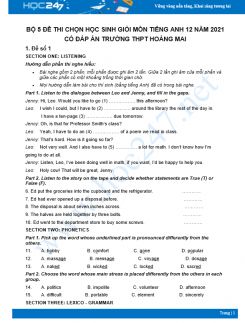
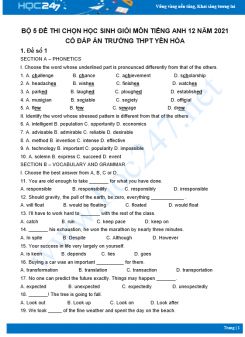
Với mong muốn giúp các em học sinh lớp 12 có thêm tài liệu ôn tập chuẩn bị cho kì thi đội tuyển sắp tới, HOC247 xin giới thiệu đến các em tài liệu Bộ 5 đề thi chọn HSG môn Tiếng Anh 12 có đáp án năm 2021 Trường THPT Hoàng Diệu gồm phần đề và đáp án giải chi tiết, giúp các em ôn tập, rèn luyện kĩ năng làm đề. Mời các em cùng tham khảo. Chúc các em đạt kết quả học tập tốt.
|
TRƯỜNG THPT HOÀNG DIỆU |
ĐỀ THI CHỌN HỌC SINH GIỎI NĂM HỌC 2020-2021 MÔN: TIẾNG ANH 12 (Thời gian làm bài: 120 phút, không kể thời gian phát đề) |
1. ĐỀ SỐ 1
Part A: PHONETICS (5 pts)
Question I: Choose the word whose underlined part is pronounced differently from the rest in the same line. (2 pts)
1. A. controlled B. returned C. formed D. convinced
2. A. suggestion B. devotion C. congestion D. digestion
Question II: Find the word with the stress pattern different from that of the other three words in each question. (3 pts)
3. A. compulsory B. curriculum C. certificate D. secondary
4. A. hospital B. different C. supportive D. special
5. A. compliment B. apologize C. tradition D. develop
Part B: VOCABULARY AND GRAMMAR (45 pts)
Question I: Choose the most suitable word or phrase to complete each sentence. (15 pts)
6. He felt when he failed the exams the second time.
A. discouraged B. discouraging C. encouraged D. encourage
7. David learned to play violin when he was at university.
A. -/- B. the/- C. the/the D. -/the
8. The workers cement for the patio when it began to rain.
A. lay B. were lying C. laid D. were laying
9. American students agree that a husband is to tell his wife where he has been if he comes home late.
A. obsessed B. obliged C. obtained D. observed
10.-"Let's have a pizza." -" "
A. Not again B. It doesn't matter C. Not really D. It’s a good idea
11. Nam: “ You are a great dancer, Huong.”
Huong: “ ”
A. There’s no doubt about it. B. You shouldn’t have saidthat.
C. You must be kidding. D. Yes. Congratulations
12. In most social situations where some is allowed, a brief raise of the hand and a small wave is fine to attract someone's attention.
A. informality B. friendship C. familiarity D. introduction
13. Sperm Whales and sharks are carnivores. Carnivores mean
A. animals that live in the sea B. animals that only eat plants
C. fish that aren’t born from eggs D. animals that eat meat
14. Will we be the storm if we shelter under a tree?
A. happy about B. safe from C. depended on D. cared for
15. Michael was with anger when he saw his car had been scratched.
A. stored B. fixed C. loaded D. filled
16. He his life to helping the poor.
A. spent B. experienced C. dedicated D. used
17. I am not really this kind of music. I prefer music that we can dance to.
A. in B. for C. into D. with
18. I had nothing for breakfast but an apple, I had lunch early.
A. However B. Since C. Due to D. Therefore
19. Military is in this country. Every man who reaches the age of 18 has to serve in the army for two years.
A. compulsory B. optional C. illegal D. unnecessary
20. All is a continuous supply of the basic necessities of life.
A. that is needed B. which is needed C. what is needed D. the thing needed
Question II: The following passage contains 10 mistakes. Find and correct them (10 pts) (Questions 21-30)
In 2001, the British Association for the Advancement of Science went on search of the world’s funniest joke. The experiment involved people from all over the world posted their jokes on to a website and rating the submissions of their. Among the jokes entered was the following: ‘There were two cows in a field. One said ‘Moo.’ The other one said ‘I was going to say that.’ The joke was then entered into the archive several times, using different animals and noises. Two tigers said ‘Grr,’ two dogs said ‘Woof’ and so on. You would imagine that one animal and noise would be much the same like another. However, the joke rated the funniest was: ‘Two ducks were sitting on a pond. One of the duck said ‘Quack.’ The other duck said, ‘I was going to say that.’ The research supported the wide held theory that some words and sounds are distinctly funnier than others. The ‘k’ sound (or the ‘hard c’) as heard in ‘quack’ and ‘duck’ have always been regarded in the comedy world as specially funny. Why? It may be down to a rather odd facial phenomenon known for ‘facial feedback’. When people feel happy they smile but some evidence suggests that the mechanism also works in reverse. The hard letter ‘k’ often forces the face to smile, which may explain why the sound is associated with happiness.
Question III: Put each verb in brackets into an appropriate form. (10 pts)
31. It was a boring show. I would rather (not/go) there.
32. I’m sure they (complete) the new road by June.
33. (Bite) twice, the postman refused to deliver our letters unless we chained our dog up.
34. His (take) ill was quite unexpected.
35. It (not/be) for you, I would come home late.
36. His roommate (always enter) the room without knocking first, which annoys him a lot.
37. The curricula of American public schools (not determine) by the federal government.
38. He (not wear) uniform when you see him, because he’ll be on leave then, and they don’t wear uniform when they are on leave.
39. It is essential that every student (know) how to use a computer.
40. A shape with four equal sides and one right angle (call) a square.
Question IV: Put each word in brackets into an appropriate form. (10 pts)
People are often put off meditation by what they see as its many mystical associations. Yet meditation is a (41. STRAIGHT) technique which merely involves sitting and resting the mind. In addition to its (42. SIMPLE) , meditation offers powerful help in the battle against stress. Hundreds of studies have shown that meditation, when undertaken in a principled way, can (43. REDUCTION) hypertension which is related to stress in the body. Research has proved that certain types of meditation can (44. SUBSTANCE) decrease key stress symptoms such as (45. ANXIOUS) and irritability. In fact, those who practise meditation with any (46. REGULAR) see their doctors less and spend, on average, seventy per cent fewer days in hospital. They are said to have more stamina, a happier (47. DISPOSE) even enjoy better relationships.
When you learn to meditate, your teacher will give you a personal 'mantra' or word which you use every time you practise the technique and which is (48. SUPPOSE) chosen according to your needs. Initial classes are taught (49. INDIVIDUAL) but subsequent classes usually consist of a group of students and take place over a period of about four days. The aim is to learn how to slip into a deeper state of (50.CONSCIOUS) themselves. for twenty minutes a day. The rewards speak for
PART C: READING COMPREHENSION (30 pts)
Question I: Read the following passage and then choose the most suitable word or phrase for each space. (10 pts)
English spelling
Why does English spelling have a reputation for being difficult? English was first written down when Christian monks came to England in Anglo-Saxon (51) .They used the 23 letters of Latin to write down the sounds of Anglo-Saxon speech as they heard it. However, English has a (52) range of basic sounds (over 40) than Latin. The alphabet was too small, and so combinations of letters were needed to (53) the different sounds. Inevitably, there were inconsistencies in the way that letters were combined. With the Norman invasion of England, the English language was put (54) risk. English survived, but the spelling of many English words changed to follow French patterns, and many French words were (55) into the language. The result was more irregularity. When the printing press was (56) in the fifteenth century, many early printers of English texts spoke other first languages. They (57) little effort to respect English spelling. Although one of the short-term effects of printing was to produce a number of variant spellings, in the long term it created fixed spellings. People became used to seeing words spelt in the same way. Rules were (58) and dictionaries were put together which printers and writers could refer to. However, spoken English was not fixed and continued to change slowly - just as it still does now. Letters that were sounded in the AngloSaxon period, like the 'k' in 'knife', now became (59) . Also, the pronunciation of vowels then had (60) in common with how they sound now, but the way they are spelt hasn't changed.
51. A. ages B. centuries C. times D. years
52. A. deeper B. longer C. thicker D. wider
53. A. explain B. express C. perform D. tell
54. A. at B. in C. on D. under
55. A. announced B. found C. introduced D. started
56. A. discovered B. invented C. made up D. taken up
57. A. brought B. did C. made D. put
58. A. drawn up B. filled in C. got across D. handed out
59. A. dump B. quiet C. silent D. speechless
60. A. much B. many C. few D. little
Question II: Supply the most suitable word for each blank. (10 pts)
--(Nội dung đầy đủ, chi tiết vui lòng xem tại online hoặc đăng nhập để tải về máy)---
ĐÁP ÁN
Part A: PHONETICS
1D 2B 3D 4C 5A
Part B: VOCABULARY & GRAMMAR
I.
6A 7B 8D 9B 10D 11C 12A 13D 14B 15D
16C 17C 18B 19A 20A
II.
MISTAKES CORRECTIONS MISTAKES CORRECTIONS
21. on (line 1) in 26. (One of) the duck (line 10)
(One of) the ducks
22. posted (line 3) posting 27. wide (line 12) widely
23. their (line 4) theirs 28. have (line 14) has
24. like (line 8) as 29. specially (line
15) especially
25 on (line 9) in 30. for (line 16) as
III.
31. not have gone 32. will have completed 33. Having been bitten 34. being taken
35. were it not 36. is always entering 37. are not determined 38. will not be
wearing
39. (should) know 40. is called
IV.
41. straightforward 42. simplicity 43. reduce 44. substantially 45. anxiety
46. regularity 47. disposition 48. supposedly 49. individually 50. consciousness
Part C: READING (30 i m – M i câu úng 1 i m)
I.
51C 52D 53B 54A 55C 56B 57C 58A 59C 60D
II.
61. to 62. addition 63. airports 64. departure 65. flight/plane
66. with 67. numbers 68. despite 69. land 70. at
III.
71B 72A 73C 74D 75A 76B 77A 78C 79C 80A
Part D: WRITING (20 i m)
I.
81. The man was too old to go on an expedition to the Middle East.
82. You drove me to distraction with your silly questions.
83. As soon as you arrive, go to the international ticket desk.
84. He broke the world record at/on his second attempt.
85. There is no instant solution to this problem.
II.
86. The two theories appear to have (got) nothing in common.
87. Much as we were impressed by the new cinema, we found/did find it rather expensive.
Impressed as we were by the new cinema, we found/did find it rather expensive.
88. The accident victim was finding it increasingly difficult to breath.
89. The damage to the building is being examined by teams of experts.
90. You ought to have thought more carefully before you decided.
2. ĐỀ SỐ 2
PART I. LISTENING
Susan comes to Barclays Bank and talks to a bank clerk. Listen to their conversation. Complete the following statements by filling in the relevant words. You should use no more than THREE words.
You will listen to the conversation TWICE.
Susan will be a (1) student.
She wants to keep her money in a safe place with easy (2) .
She is suggested to open an (3) Account.
The facilities the current account provides are (4) and a deposit book.
There are (5) of interest for this account.
If the balance is up to 500 pounds, the interest is (6) .
If the balance is over 500 pounds, the interest goes up to (7) .
The bank statement shows you the permanent record of income and (8) .
Cashcard can be used to (9) and (10) the balance.
PART II. GRAMMAR AND VOCABULARY
I. Complete the following sentences by choosing the correct answer among four options (A, B, C or D).
1. She looked very _ when I told her the good news.
A. happily B. happiness C. happy D. was happy
2. I don't want much sugar in my coffee. Just , please.
A. few B. a few C. little D. a little
3. He's left his book at home; he's always so _.
A. forgetful B. forgettable C. forgotten D. forgetting
4. 'I'm very to you for putting in so much hard work,' the boss said.
A. thanking B. grateful C. considerate D. careful
5. Steel with chromium to produce a noncorrosive substance known as stainless steel.
A. is combined B. that is combined C. combining D. when combined
6. Joe seemed to be in a good mood, he snapped at me angrily when I asked him to join us.
A. yet B. so C. for D. and
7. A fire must have a readily available supply of oxygen. , it will stop burning.
A. Consequently B. Furthermore C. Otherwise D. However
8. “Who has brothers and sisters?”
“Everyone Virginia who’s an only child.”
A. except to B. with C. from D. but
9. He is the manager of the factory. He’s _it.
A. charged with B. charged C. in charge D. in charge of
10. He was new on the job, but he quickly fit himself into the routine of the office.
A. establishing B. established C. establishes D. establish
11. Florida, the Sunshine State, attracts many tourists every year.
A. is B. is known as C. known as D. that is known as
12. becoming extinct is of great concern to zoologists.
A. That giant pandas are B. Giant pandas are
C. Are giant pandas D. Giant panda is
13. Her parents gave her everything she asked for. She's a completed child.
A. wounded B. spoilt C. damaged D. destroyed
14. my experience, very few people really understand the problem.
A. To B. In C. With D. From
15. When she died, she gave all her money to a charity for cats.
A. away B. out C. on D. off
BY BÌNH – THPT LI N S N, L P TH CH, V NH PHÚC www.violet.vn/quocbinh72
II. Complete the following passage by supplying the correct form of the word to fill in each blank.
The increase in city crime is a global phenomenon. Some people say that a lot of crime in this country is because of (1 - migrate) and the new people arriving from other countries bring different (2 - culture) values and attitudes to the law. I don’t agree with this idea because the most common crimes are (3 - local) produced and not imported from other countries. (4 - Vandal) _ is one of the biggest crimes in my city with bus shelters and shop windows being popular targets. Another popular crime is (5 - pay) parking fines, which is unlikely to be because of immigrants because most of them do not own cars. The (6 - oppose) point of view is that young local people feel angry when they can’t get a job and in order to (7 - hand) the change in their environment, they strike out at easy targets. This would explain why bicycle (8 - thief) is more common than car crime these days, especially in rich (9 - neighbors) where most cars are protected with electronic alarms. Another
reason, though, for so many bicycles getting stolen might be that the (10 - punish) is not very
severe compared to car stealing which can land you in prison for a number of years.
III. Fill in each blank with one suitable preposition.
1. Most American men earn average about $110 a week.
2. He was walking through the park when a strange dog suddenly went him.
3. My car is not worth much most $ 50.
4. I’d better not drink that milk, Joe. It’s gone .
5. Clive was really cut when he failed his proficiency exam.
IV. Identify the error in each sentence. Write the corresponding letter A, B, C or D on the answer sheet.
1. The children forgot picking up the note from the office and now they are worried.
2. Helen has never met such good person who is ready to help others.
3. If only I have done the test better than other students did.
4. If you want to borrow my car, promise to drive careful.
5. Rumors began circulating that the Prime Minister was seriously illness.
6. Everybody in class has to choose a topic of your own to write an essay of 500 words.
7. Neither of the boys had ever been out of town before, so they were really exciting.
8. I hope that I can help you with the historic questions.
9. My son learned to talk the time before he was 5 years old.
10. Jim offered us presents as if it had been Xmas.
PART III: READING
I. Read the passage carefully, then choose the correct option (marked A, B, C or D) to answer the questions.
Million of people are using cell phones today. In many places, it is actually considered unusual not to use one. In many countries, cell phones are very popular with young people. They find that the phones are means of communication – having a mobile phone shows that they are cool and connected.
The explosion in mobile phone use around the world has made some health professionals worried.
Some doctors are concerned that in the future many people may suffer health problems from the use of mobile phones. In England, there has been a serious debate about this issue. Mobile phone companies are worried about the negative publicity of such ideas. They say that there is no proof that mobile phones are bad for your health.
On the other hand, medical studies have shown changes in the brain cells of some people who use mobile phones. Signs of change in the issues of the brain and head can be detected with modern scanning equipment. In one case, a traveling salesman had to retire at young age because of serious memory loss. He couldn't remember even simple tasks. He would often forget the name of his own son. This man used to talk on his mobile phone for about six hours a day, every day of his working week, for a couple of years. His family doctor blamed his mobile phone use, but his employer's doctor didn't agree. What is it that makes mobile phones potentially harmful? The answer is radiation. High – tech machines can detect very small amounts of radiation from mobile phones. Mobile phone companies agree that there is some radiation, but they say the amount is too small to worry about. As the discussion about their safety continues, it appears that it's best to use mobile phones less often. Use your regular phone of you want to talk for a long time. Use your mobile phone only when you really need it. Mobile phones can be very useful and convenient, especially in emergencies. In the future, mobile phones may have a warning label that says they are bad for your health. So for now, it's wise not to use your mobile phone too often.
1. According to the passage, cell phones are especially popular with young people because .
A. they are indispensable in everyday communication
B. they make them look more stylish
C. they keep the users alert all the time
D. they cannot be replaced by regular phones
2. The changes possible caused by the cell phones are mainly concerned with .
A. the mobility of the mind and the body B. the smallest units of brain
C. the arteries of the brain D. the resident memory
3. The word "means" in the passage most closely means .
A. meanings B. expression C. method D. transmission
4. The word "potentially" in the passage most closely means .
A. obviously B. possibly C. certainly D. privately
5. "Negative publicity" in the passage most likely means .
A. information on the lethal effects of cell phones
B. widespread opinion about bad effects of cell phones
C. the negative public use of cell phones
D. poor ideas about the effects of cell phones
6. Doctors have tentatively concluded that cell phones may .
A. damage their users' emotions B. cause some mental malfunction
C. change their users' temperament D. change their users' social behavior
7. The man mentioned in the passage, who used his cell phone too often .
A. suffered serious loss of mental ability B. could no longer think lucidly
C. abandoned his family D. had a problem with memory
8. According to the passage, what makes mobile phones potentially harmful is .
A. their radiant light B. their power of attraction
C. their raiding power D. their invisible rays
9. According to the writer, people should .
A. only use mobile phones in urgent cases
B. only use mobile phones in medical emergencies
C. keep off mobile phones regularly
D. never used mobile phones in all cases
10.The most suitable title for the passage could be .
A. "The reasons why mobile phones are regular" B. "Technological Innovation and their price"
C. "They way mobile phones work" D. "Mobile phones – a must of our time"
II. Complete the following passage by choosing A, B, C or D to fill in each blank.
Stamp collecting! What a wonderful hobby! I began when I was only five. I used to (1) for the postman's arrival, always (2) to seize unwanted envelopes and tear off the corner with the stamp stuck on it.
Once – I remember it was too clearly – my mother and father were sunning themselves in the garden when the post (3) on the doormat. I heard the clatter of the letter flap and hurriedly went to (4) . There were four or five envelops, all with very exciting stamps. Even at the (5) age of five I knew one doesn't open mail addressed to other people.
However, tearing just the corners off the envelops (6) me as perfectly fair and allowable, and just what I did. I carefully tore as (7) to the stamps as (8) , feeling that even the envelopes, which were addressed to my parents and not to be, should be treated with (9) . There were nothing furtive in what I did. I knew my parents would see what I'd done, and I didn't think there was any (10) in it. They always let me (11) _ the corners after they'd opened them. Why should I think there was any harm in doing it first, (12) in mind that they weren't on hand to be (13) . Wouldn't they rather be left to doze in their summer deckchairs? (14) , though, my father solemnly showed me his letters. They looked distinctly moth-eaten, with bites taken out of the corners and sites. I began to (15) what I've done.
1. A. stare B. watch C. look D. peer
2. A. glad B. pleased C. eager D. excited
3. A. came B. was C. lay D. arrived
4. A. investigate B. observe C. see D. notice
5. A. junior B. tender C. small D. little
6. A. struck B. seemed C. appeared D. felt
7. A. nearby B. close C. next D. round
8. A. able B. possibly C. possible D. could
9. A. gentleness B. caution C. honor D. respect
10. A. trouble B. wrong C. bad D. harm
11. A. take B. tear C. cut D. remove
12. A. having B. holding C. bearing D. keeping
13. A. consulted B. advised C. queried D. requested
14. A. After B. Then C. Later D. Soon
15. A. accept B. realize C. admit D. confess
III. Read the following passage and answer the questions that follow. Write A, B, C or D to indicate your answers on the answer sheet.
Every drop of water in the ocean, even in the deepest parts, responds to the forces that create the tides. No other force that affects the sea is so strong. Compared with the tides, the waves created by the wind are surface movements felt no more than a hundred fathoms below the surface. The currents also seldom involve more than the upper several hundred fathoms despite their impressive sweep.
The tides are a response of the waters of the ocean to the pull of the Moon and the more distant Sun. In theory, there is a gravitational attraction between the water and even the outermost star of the universe. In reality, however, the pull of remote stars is so slight as to be obliterated by the control of the Moon and, to a lesser extent, the Sun. Just as the Moon rises later each day by fifty minutes, on the average, so, in most places, the time of high tide is correspondingly later each day. And as the Moon waxes and wanes in its monthly cycle, so the height of the tide varies. The tidal movements are strongest when the Moon is a sliver in the sky, and when it is full. These are the highest flood tides and the lowest ebb tides of the lunar month and are called the spring tides. At these times the Sun, Moon, and Earth are nearly in line and the pull of the two heavenly bodies is added together to bring the water high on the beaches, to send its surf upward against the sea cliffs, and to draw a high tide into the harbors. Twice each month, at the quarters of the Moon, when the Sun, Moon and Earth lie at the apexes of a triangular configuration and the pull of the Sun and Moon are opposed, the moderate tidal movements called neap tides occur. Then the difference between high and low water is less than at any other time during the month.
1. What is the main point of the first paragraph?
A. The waves created by ocean currents are very large.
B. Despite the strength of the wind, it only moves surface water.
C. Deep ocean water is seldom affected by forces that move water.
D. The tides are the most powerful force to affect the movement of ocean water.
2. The words "In reality" in the passage is closest in meaning to
A. surprisingly B. actually C. characteristically D. similarly
3. It can be inferred from the passage that the most important factor in determining how much gravitational effect one object in space has on the tides is
A. size B. distance C. temperature D. density
4. The word "configuration" in the passage is closest in meaning to
A. unit B. center C. surface D. arrangement
5. Neap tides occur when
A. the Sun counteracts the Moon's gravitational attraction
B. the Moon is full
C. the Moon is farthest from the Sun
D. waves created by the wind combine with the Moon's gravitational attraction
PART IV. WRITING
--(Nội dung đầy đủ, chi tiết vui lòng xem tại online hoặc đăng nhập để tải về máy)---
ĐÁP ÁN
PART I. LISTENING (15 pts: 1,5/item
1. college 2. access 3. Instant 4. a cashcard 5. two levels
6. 5.25% 7. 7.25% 8. expenditure 9. withdraw money 10. check
PART II. GRAMMAR AND VOCABULARY (35pts)
I. (15pts: 1/item)
1. C 2. D 3. A 4. B 5. A
6. A 7. C 8. D 9. D 10. B
11. C 12. A 13. B 14. B 15. A
II. (10pts: 1/item)
1. immigration 3. locally 5. unpaid 7. handle 9. neighborhoods
2. cultural 4. vandalism 6. opposing 8. theft 10. punishment
III. (5pts: 1pt/item)
1. on 2. for 3. at 4. off 5. up
IV. (5pts: 0.5 pt/ item)
1. A 3. A 5. D 7. D 9. B
2. B 4. D 6. C 8. D 10. D
PART III. READING (30 pts)
I. (10pts: 1/item)
1. A 2. C 3. C 4. B 5. B
6. B 7. D 8. A 9. A 10. B
II. (15pts: 1/item)
1. B 2. C 3. D 4. A 5. B
6. A 7. B 8. C 9. D 10. D
11. D 12. C 13. A 14. C 15. B
III. (5pts: 1pt/item)
1. D 2. B 3. B 4. D 5. A
PART IV. WRITING (20pts)
I. (10pts: 1/item)
1. regret to inform/to tell you/announce that
2. he had meant to phone Sarah
3. is considered/thought to be
4. try holding your breath
5. resented one of her colleagues getting
6. and I get on
7. I hadn't used up
8. had already left when/before
9. in spite of not wearing
10. a sense of achievement
II. (10pts: 1pt/item)
1. Thank you very much for the French cookery book you gave me.
2. The recipes look wonderful, and I'll certainly enjoy using it.
3. I hope you and Auntie Susan had a good Christmas.
4. We stayed at home, but had a couple of day trips out nearby.
5. Our local theatre put on a production of "A Christmas Carol", which was fun.
6. I am going back to University next week, and this year I'm going to have to study hard for the final exams.
7. I've really enjoyed the course so far, but I'm not sure what to do once I get my degree.
8. The University arranges career interviews, but I don't really have a clear idea of what I want to do.
9. Hopefully it will all become clearer during the course of the year.
10. Thank you again for the lovely present, and Happy New Year!
Susan comes to Barclays Bank and talks to a bank clerk. Listen to their conversation.
Clerk: Good morning. What can I do for you?
Susan: Good morning. I’d like to open a bank account.
Clerk: What kind of account do you want?
Susan: I’m not quite sure. I’ll be a college student. I simply require a safe place to keep my money and easy access to it. Can you recommend an account for me?
Clerk: All right. Do you get a grant?
Susan: No. I will be supporting myself.
Clerk: I see. You could open an Instant Account.
Susan: What’s an Instant Account?
Clerk: Basically, it’s an interest account. It has all the usual current account facilities such as cashcard and a deposit book, except a chequebook, and pays competitive interest on your account when it’s in credit. There are two levels of interest for this account. If your balance is up to five hundred pounds, the interest is five point two-five percent. If your balance is five hundred or over, it attracts an even higher rate of interest which goes up to seven point two – five percent. You will receive a cashcard for our machines, so you can withdraw money with the card from any machines at any Barclays branches when the bank is closed.
Susan: Oh, I see. How can I withdraw money if I have no chequebook?
Clerk: Well, you have to withdraw money either using your card or visiting your branch.
Susan: I see. How can I find out how much money I have in my account?
Clerk: You can ask your branch and tell them how often you would like to receive your statement, which provides you with a permanent record of income and expenditure. It will show every transaction on your account and the balance remaining at the end of each day. You also can see your cashcard to check your balance.
Susan: That’s fine. I think I’ll open an Instant Account
3. ĐỀ SỐ 3
SECTIONI–PHONETICS
I.Choose the word whose underlined part is pronounced differently from the rest in the same line.( 5p)
1.A.several B. suppose C. decisive D. sister
2.A. muddle B. struggle C. bush D. interrupt
3.A. ready B. measure C. steak D. stealth
4.A. wind B. behind C. mind D. find
5.A.chalice B. challenge C. choice D. chemist
II. Pick out the word that has the stress syllable differently from that of the other words.(5p)
1.A. application B. certificate C. biology D. security
2. A. university B. punctuality C. agricultural D.mathematician
3. A. identify B. secondary C. luxuriously D. majority
4. A. academic B. engineering C. availabe D.sympathetic
5.A. obligatory B. geographical C. international D. undergraduate
SECTION II- VOCABULARY AND GRAMMAR
I. Choose the best option ( A, B, C or D) to complete sentence below and write your answers in the answer sheet.( 10p)
1. She refused to eat meat under any ………………… .
A. circumstances B. occasion C. opportunity D. reason
2. It was difficult to guess what he ……………. to the news would be.
A. feelings B. reaction C. capital D. opinion
3. Though badly damaged by fire, the palace was eventually …… to its original splendour.
A. repaired B. renewed C. restored D. renovated
4. He didn’t know anyone at the wedding ………….. than the bride and the groom.
A. except B. other C. apart D. rather
5. When you are an old age pensioner, you have to learn to ………… a very small income.
A. live on B. live up to C. live out D. live down
6. I felt so much better, my doctor ………….. me to take a holiday by the sea.
A. suggested B. considered C. accepted D. advised
7. He said that the plane had already left and that I …………….. arrived an hour earlier.
A. must have B. had to C. should have D. was supposed to
8. Alice didn’t expect ……………. to Bill’s party.
A. to ask B. being asked C. to be asked D. asking
9.The restaurants on the island are expensive, so it’s worth ……………… a packed lunch.
A. take B. to take C. taking D. taken
10. When the alarm went off, Mick just turned ………..…. and went back to sleep.
A. down B. over C. up D. out
II.Put the verb in brackets into the correct tense.( 10p)
1.When he ( not arrive) ……….. by 6.00, I ( know) ………. He ( miss) ………… the bus.
2. Something ( tell) ………….. me that you ( not listen) …………… to a single word I (say) ……….. in the past tense minutes.
3. Same ( not receive) ……………..…… the parcel the last time I ( speak) …………….. to him.
4. When you ( feel) ……….… hungry, room service ( bring) ………….. you whatever you want.
III. Give the correct forms of the words in brackets to complete the blank space. ( 10p)
1.The judges describe Jones as a ….. criminal who was a danger to members of the public. HARD
2. Rescue team held out little hope of finding other …………. SURVIVE
3. He works for UNESCO in a purely ………….. role. ADVICE
4. …………… of the new system will take several days. INSTALL
5. This type of behaviour is no longer …………. acceptable. SOCIETY
6. Watching television can be very …………….. EDUCATION
7. Teachers must keep a record of students’ ……………….. ATTEND
8. Our school set up a project to ……………. the library system. COMPUTER
9.The breakdown of the negotiations was not ……………….. EXPECT
10. Those countries are ……. on other countries for most of their food. DEPEND
IV. Fill in each gap with a suitable preposition. (10 points)
1.……………… behalf of the department I would like to thank you all.
2. Many people expressed a strong preference …………. the original plan.
3. They were refused entrance ………… the exhibition .
4. He graduated …………….. York with a degree in Psychology.
5. We had an argument ………….. the waiter about the bill.
6. She complimented him ………….. his exellent German.
7. She sacrificed everything ……………. her children.
8. Sit down and make yourself ……………. home.
9. He works away …………… home during the week.
10. The searchers spread ………….. to over the area faster.
SECTION III – READING
I.Read the following passage carefully and then answer the questions below.(10p)
Traditionally the United States has been described as a melting pot, a place where the previous identities of each immigrant group are melted down to create an intergrated, uniform society. Since the 1960s, many Americans have rejected the melting pot metaphor in favour of the image of the mosaic, a picture created by assembling many small stones or tiles. In a mosaic, each peace retains its own distinctive identity, while
contributing to a larger design. Advocates of the mosaic metaphor assert that it better represents the diverse multicultural society of the United States. Today, may Americans value their immigrant heritage as an important part of their identity. More recent immigrant groups from Asia, such as Vietnamese Americans and Korean Americans, have established communities alongside those populated by the descendants of European immigrants, such as French Americans, German Americans, Irish Americans and Italian Americans.
1.Why has the United States often been described as a melting pot?
2. Why have people been in favour of the image of the “ mosaic”?
3. What does the word “mosaic” mean?
4. What have immigrant groups from Asia done to maintain their identity?
5. Name some recent immigrant groups from Asia in the United States?
II.Read the following passage and then choose the most suitable word for each space. (10 p)
CAR CATCHES FIRE
Three people jumped ……………( 1) a car on a busy Oxford road after a fire started under the bonnet this morning. They were just able to rescue their possessions before the car burst into …………..(2). Mr. Peter Collins, 25, of Wey Road, Berinsfield …………….(3) his Avenger astate car home ………….(4) work with two friends when he noticed smoke coming into the car. He stopped, …………(5) was unable to open the bonnet. He poured a bottle of water over the radiator where the smoke was coming from, but could not put out the flames. He then ………… (6) to get fire extinguishers from a nearby…………(7) , but ………….(8) also failed to have any effect. ……….(9) he telephoned for a ……..(10) , but by the time it arrived, the car was totally burned out.
1. A. into B. on C. out of D. over
2. A. flames B. petrol C. smoke D. sparks
3. A.drove B. has driven C. was driving D. was driven
4. A. to B. from C. at D. in
5.A. but B. because C. although D. so
6. A. wandered B. jumped C. walked D. ran
7.A. hospital B. garage C.library D. swimming pool
8. A. this B. those C. that D. these
9. A. At length B.Finally C. At the end D. Terminally
10. A. police car B. ambulance C. taxi D. fire engine
III.Read the passage below carefully. Then choose the correct answer: A, B, C or D that best answers the question about the passage. (5p)
When we were in England last year, I went fishing with my friend, Peter. Early in the morning we were sitting quietly by the side of the lake when we had an unpleasant surprise. We saw a duck come along with three ducklings padding cheerfully behind her. As we watched them, there was a sudden swirl in the water. We caught a glimpse of the vicious jaws of a pike- a fish which is rather like a freshwater shark- and one of the ducklings was dragged below the surface.
This incident made Peter furious. He vowed to catch the pike. On three successive mornings we returned to the vicinity and used several different kinds of bait. On the third day Peter was lucky. Using an artificial frog as bait, he managed to hook the monster. There was a desperate fight but Peter was determined to capture the pike and succeeded. When he had got it ashore and killed it, he wieghed the fish and found that it scaled nearly thirty pounds- a record for that district.
--(Nội dung đầy đủ, chi tiết vui lòng xem tại online hoặc đăng nhập để tải về máy)---
ĐÁP ÁN
SECTION I: Phonetics (10 POINTS)
I. A. (1p for 1 correct answer X 5 = 5 points)
1. B 2. C 3. C 4. A 5. D
B. (1p for 1 correct answer X 5 = 5 points)
1.A 2.D 3.B 4.C 5.A
SECTION II: VOCABULARY AND GRAMMAR (40 POINTS)
I . (1p for 1 correct answer X 10 = 10 points)
1.A 2. B 3. C 4. B
5. A
6. D 7. C 8. C 9. C
10. B
II .( 1p for 1 correct answer X 10 = 10 points)
1. didn’t arrive/ knew/ hadn’t missed
2. tells/ haven’t been listening/ have said
3. hadn’t received/ spoke
4. feel/ will bring
III .( 1p for 1 correct answer X 10 = 10 points)
1. hardened 6. eduacational
2. survivors 7. attendances
3. advisory 8. computerize
4. Installation 9. unexpected
5. socially 10. dependent
IV .( 1p for 1 correct answer X 10 = 10 points)
1. On 6. on
2. for 7. for
3. to 8. at
4. from 9. from
5. with 10. out
SECTION III.reading (25 POINTS)
I.(10 points): 2 pts/ each correct answer.
1. Because the United States is a place where the previous identities of each immigrant group are melted down to create an intergrated, uniform society.
2. Because it better represents the diverse multicultural society of the United States.
3.It means a picture create by assembling many small stones or tiles.
4. They have established communities alongside those populated by the descendants of European immigrants.
5. They are Vietnamese Americans and Korean Americans.
II. (10 points): 1 pts/ each correct answer.
1.C 2. A 3. C 4. B
5. A
6. D 7. B 8. D 9. B
10. D
III.(5 points): 1 pts/ each correct answer.
1. D 2. C 3. B 4. C 5. C
SECTION IV : WRITING (25 POINTS)
I.( 1p for 1 correct answer X 5 = 5 points)
1. If it hadn’t been for your unsuspected talents as a mechanic, we would have been stranded there for hours.
2. He suggested inviting the Browns to the party on Sunday.
3. Had it not been for the death of the Prime Minister, the bill would have been passed.
4. That commentator, whose name I’ve forgotten, is very well-known.
5. Not until he came into the light did I recognise him.
II.( 1p for 1 correct answer X 5 = 5 points)
1. It’s worth asking George to help.
2. I haven’t seen him since I lived in London.
3. I am not used to going into town by car.
4. He plays this piece more beautifully than anybody/ anyone else.
5. I was prevented from going to work by transport strike.
III.( 1p for 1 correct answer X 5 = 5 points)
1.Teacher’s day in Vietnam falls on the twentieth of November each year.
2. Generally/ In general, it is meant for schoolchildren to show their appreciation to their teachers who have
guided them in their studies.
3. It is a time to forget the bad experiences students may have of their teachers scolding and punishing them.
4. Students give their teachers flowers and small gifts.
5. Small parties are held and there is an atmosphere of fun and amazenment in the school.
II.10 points
1. Form: an essay (2points)
+ Easy to read
+ Coherent
2. Content: ( 4 points)
+Successful fulfillment of the task.
3. Language: ( 4 points)
+ Appropriate vocabulary (1 point )
+ Suitable connectors (0.5 point )
+ Correct grammar (2 points )
+ Punctuating/ Spelling (0.5 point)
4. ĐỀ SỐ 4
I. PHONETICS
Part 1: Circle the word whose underlined part is pronounced differently from that of the others in each group. Circle A, B, C or D to indicate your answer. (5 pts)
1. A. arrow B. loud C. moldy D. poultry
2. A. basilisk B. bison C. basic D. basin
3. A. subtlety B. indebtedness C. bombard D. combing
4. A. benevolent B. content C. molecules D. technique
5. A. conscience B. bronchitis C. shuttle D. chauffeur
Part 2: Choose the word whose syllable is stressed differently from that of the others in each
line. Circle A, B, C or D to indicate your answer. (5 pts)
6. A. comic B. clementine C. climax D. thermonuclear
7. A. diligent B. dimension C. action D. innate
8. A. characterize B. absence C. datum D. charcoal
9. A. solicitor B. separately C. spacious D. sequence
10. A. parachute B. armchair C. accent D. accidentally
II. LEXICO – GRAMMAR
Part 1: Choose the word or phrase that best completes each sentence. Circle A, B, C or D to indicate your answer. (20 pts)
11. Assembly lines are useful for producing a large of identical products.
A. quality B. quantity C. quandary D. qualification
12. Only the of the building is going to be remodeled.
A. insides B. interior C. indoors D. inner
13. Whether the sports club survives is a matter of complete to me.
A. indifference B. disinterest C. importance D. interest
14. After years of neglect there was a huge program to return the city to its former glory.
A. restoration B. preservation C. conservation D. refurbishment
15. The assistant suggested the next day when the manager would be there.
A. we are coming back B. to come back C. we will come back D. we came back
16. I never get a of sleep after watching a horror film.
A. wink B. blink C. night D. ounce
17. As it was Christmas, the at church was much larger than usual.
A. audience B. convention C. congregation D. grouping
18. The sheep were huddled into a to protect them from overnight frosts.
A. cage B. kennel C. hutch D. pen
19. The jury the defendant “not guilty”.
A. gave B. returned C. subscribed D. found
20. Many crafts such as weaving are now being revived.
A. customary B. habitual C. traditional D. ordinary
21. He managed to finish his thesis under the of his tutor.
A. guidance B. help C. aid D. assistance
22. Mr. Henry was given a medal in of his service to his country.
A. gratitude B. knowledge C. recognition D. response
23. Everyone knows about pollution problems, but not many people have any solutions.
A. thought over B. come up with C. looked into D. got round to
24. You as well seek for a fish in the tree as try to do that.
A. must B. would C. should D. might
25. calculations have shown that the earth’s resources may run out before the end of the next century.
A. Raw B. Rude C. Crude D. Blunt
26. By the time you receive this letter, I for China.
A. will have left B. have left C. would have left D. will leave
27. Prizes are awarded the number of points scored.
A. resulting from B. adding up C. presented to D. according to
28. The needs of gifted children in schools have long been neglected.
A. dolefully B. woefully C. idly D. pathetically
29. I must take this watch to be repaired; it over 20 minutes a day.
A. increases B. gains C. accelerates D. progresses
30. It had been a trying afternoon, at about six o’clock in the television breaking down.
A. culminating B. leading C. arriving D. finalizing
Part 2: Write the correct FORM of each bracketed word in the numbered space provided in the column on the right. (0) has been done as an example. (10 pts)
According to some (0) (SCIENCE), high-risk sports can be particularly (31) (VALUE) for certain types of people. Such activities help them to learn that being (32) (FRIGHT) doesn’t mean that they have to lose control. The recent fashion for jumping from bridges attached to a (33) (LONG) of elastic rope, known as “bungee jumping”, has now been tried by over one million people (34) (WORLD) and interest in it is continuing to grow.
Before the special elastic rope (35) (TIGHT) around them, jumpers reach speeds of nearly 160kph. First-timers are usually too (36) (TERROR) to open their mouths, and when they are finally (37) (LOW) safely to the ground, they walk around with broad smiles on their faces, saying (38) (REPEAT) how amazing it was. However, for some people, it is only the (39) (EMBARRASS) of refusing to jump at the last minute that finally persuades them to conquer their fear of (40) (HIGH) and push themselves off into space.
0. scientists
31.
32.
33.
34.
35.
36.
37.
38.
39.
40.
Part 3: The passage below contains 10 mistakes. Underline the mistakes and write their correct forms in the space provided in the column on the right. (0) has been done as an example. (10 pts)
Traditional, mental tests have been divided into two types.
Achievement tests are designed to measure acquiring skills and
knowledge, particularly those that have been explicitness taught. The
proficiency exams required by few states for high school graduation
are achievement tests. Aptitude tests are designed and measure a
person’s ability to acquire new skills but knowledge. For example,
vocation aptitude tests can help you decide whether you would do
better like a mechanic or musician. However, all mental tests are in
some sense achievement tests because they assumption some sort
of past learning or experience with certainly objects, words, or
situations. The difference between achievement and aptitude tests is
the degree and intention use.
0. traditional traditionally
41.
42.
43.
44.
45.
46.
47.
48.
49.
50.
Part 4: Fill in each of the gaps with the correct preposition or particle. Write your answers in the numbered spaces provided below the passage. (10 pts)
The show was fully booked (51) for weeks, and when it opened last night, the public poured (52) and very soon the London Arts Center was packed (53) . But why? What did they come to see?
They came to see human beings take (54) circus animals, men in cat suits who stood (55) for real lions and tigers. The show was put (56) by its creators to protest (57) traditional circuses and to send a message about cruelty to animals. The show was timed to tie (58) with the National Protection of
Animals Week. It was a good idea, but the standard of the performances was third-rate and an embarrassing number of people simply walked (59) before it ended. There were some amusing moments when the performers sent (60) typical circus folks, but overall it was a dismal show. Despite the large turnout for the show’s first night, I doubt it will attract many people during the rest of its seven-day run.
Part 5: Complete each sentence with the correct form of ONE of the phrasal verbs below. Write your answers in the numbered spaces provided below the passage. Each verb is used only once. (10 pts)
try out slip up carry on get by put out
take after get down look up go through turn down
61. If you’re finding it difficult to on your salary, why don’t you ask for a raise?
62. I know what you’re and I feel really sorry for you.
63. In many ways you your father.
64. If you you’ll get into trouble.
65. I proposed to her but she me .
66. You’d better your cigarette because smoking isn’t allowed in here.
67. If you working so hard, you’ll make yourself ill.
68. Stop worrying about it. Don’t let this failure you .
69. The car’s in quite good condition but you can it before you make any decision to buy,
70. When I was in New York, I was able to several old friends I hadn’t seen for years.
Part 6: Insert A, AN, THE or Ø (zero article) where necessary. Write your answers in the numbered spaces provided below the passage. (10 pts)
--(Nội dung đầy đủ, chi tiết vui lòng xem tại online hoặc đăng nhập để tải về máy)---
ĐÁP ÁN
I. PHONETICS: 1/20 points
Part 1: (5 x 0.1 = 0.5)
1. B 2. A 3. C 4. C 5. B
Part 2: (5 x 0.1 = 0.5)
6. D 7. B 8. A 9. A 10. D
II. LEXICO – GRAMMAR: 6/20 points
Part 1: (20 x 0.05 = 1)
11. B 12. B 13. A 14. A 15. D
16. A 17. C 18. D 19. D 20. C
21. A 22. C 23. B 24. D 25. C
26. A 27. D 28. B 29. B 30. A
Part 2: (10 x 0.1 = 1)
31. value valuable 36. terror terrified
32. fright frightened 37. low lowered
33. long length 38. repeat repeatedly
34. world – worldwide 39. embarrass embarrassment
35. tight tightened 40. high heights
Part 3: (10 x 0.1 = 1)
41. acquiring acquired 46. vocation vocational
42. explicitness explicitly 47. like as
43. few a few 48. assumption assume
44. and to 49. certainly certain
45. but to 50. intention intended
Part 4: (10 x 0.1 = 1)
51. up 52. in 53. out 54. off 55. in
56. on 57. against 58. in 59. out 60. up
Part 5: (10 x 0.1 = 1)
61. get by 62. going through 63. take after 64. slip up 65. turned down
66. put out 67. carry on 68. get down 69. try out 70. look up
Part 6: (10 x 0.1 = 1)
71. a 72. the 73. a 74. the 75. the
76. a 77. an 78. a 79. the 80. Ø
III. READING COMPREHENSION: 4/20 points
Part 1: (10 x 0.1 = 1)
81. B 82. C 83. C 84. A 85. D
86. C 87. D 88. B 89. A 90. D
Part 2: (10 x 0.1 = 1)
91. whether 92. put 93. in 94. union 95. free
96. but 97. enable 98. most 99. make 100. of
Part 3: (10 x 0.2 = 2)
101. A 102. B 103. C 104. D 105. C
106. A 107. C 108. B 109. D 110. B
IV. WRITING: 6/20 points
Part 1: (5 x 0.2 = 1)
111. An increased number of travellers is being stopped by customs officials this week.
112. Rather than disturb the meeting, I left without saying goodbye.
113. The moment I decided to get up to dance, the band decided to stop playing.
114. At no time did he suspect that the bicycle had been stolen.
115. Other than to offer to lend her some money, how could I help?
Part 2: (5 x 0.2 = 1)
116. his achievements are unsurpassed. 117. pulled a face as he swallowed.
118. will take longer than originally planned, which is. 119. whetted my appetite for the rest of.
120. not to drive for fear of.
5. ĐỀ SỐ 5
Part I: Choose the best answer among A, B, C or D.
1. Our holiday was by the weather.
A. spoilt B. damaged C. overcome D. wasted
2. The charged by the architect for the plans of the new building were unusually high.
A. hire B. price C. fees D. sum
3. He his son of the dangers of driving too fast in his new car
A. warned B. remembered C. threatened D. concerned
4. The child was by a lorry on the safety crossing in the main street.
A. knocked out B. run across C. run out D. knocked down
5. When Ali arrived in London he spent all his time and visited all the important museums and buildings.
A. sight-seeing B. traveling C. looking D. touring
6. If you want a cheap air ticket you must well in advance.
A. book B. engage C. reserve D. buy
7. His sister was full of for the way in which he had so quickly learned to drive a car.
A. pride B. admiration C. surprise D. jealousy
8. He asked if we would to share the room.
A. accept B. consider C. agree D. approve
9. I wondered whether you would like to to the theater tomorrow.
A. visit B. go away C. go out D. walk out
10. I would like to say how pleased I am to be here.
A. Primarily B. Foremost C. Earliest D. First
11. The independent arbitrator managed to the confrontation between the union and the employers.
A. refuse B. confuse C. refute D. defuse
12. When I heard the footsteps behind me I was that I would be attacked.
A. horrified B. terror-struck C. terrorized D. terrified
13. His illness made him of concentration.
A. incompetent B. unable C. incapable D. powerless
14. Has the committee a decision yet?
A. done B. made C. arrived D. voted
15. I am a bit hungry. I think something to eat.
A. I’ll have B. I’ll be having C. I’m going to have D. I’m having
16. What do you plan to do when you your course at college?
A. finish B. will finish C. have finished D. is going to finish
17. Where ? Which hairdresser did you go to?
A. did you cut your hair B. have you cut your hair C. did you have cut your hair D. did you have your hair cut
18. ‘Shall I stay here?’ ~ ‘I’d rather with us’.
A. you come B. you to come C. you would come D. you came
19. I saying what I think.
A. believe B. believe in C. believe for D. believe when
20. Somebody ran in front of the car as I was driving. Fortunately I just in time.
A. could stop B. could have stopped C. managed to stop D. must be able to stop
Part II: The passage below contains 10 mistakes. Underline the mistakes and write their correct forms in the space provided in the column on the right. (0) has been done as an example.
Traditional, mental tests have been divided into two types. 0. traditional traditionally
Achievement tests are designed to measure acquiring skills and 1.
knowledge, particularly those that have been explicitness taught. The 2.
proficiency exams required by few states for high school graduation 3.
are achievement tests. Aptitude tests are designed and measure a 4.
person’s ability to acquire new skills but knowledge. For example, 5.
vocation aptitude tests can help you decide whether you would do 6.
better like a mechanic or musician. However, all mental tests are in 7.
some sense achievement tests because they assumption some sort 8.
of past learning or experience with certainly objects, words, or 9.
situations. The difference between achievement and aptitude tests is 10.
the degree and intention use.
Part III: Give the correct form of the words in brackets to fill in the blanks.
Dark black clouds in a dull sky meant one thing and one thing only: there was going to be a (1.thunder)….. Not
one of us had brought an umbrella, or even a (2.rain)……. So when Jack suggested we should go to a museum, we all agreed immediately. As we had been (3. shop)………all morning we were now feeling very tired, it would be a (4. pleasant)………...to sit down. We took a bus and arrived just as large shops of rain were beginning to fall.
The museum was quite (5.desert)……and very peaceful. We sat down in the main hall and listened to the rain (6. beat)…….against the windows.
Suddenly, there was a great (7. disturb)……..at the (8. enter)……… a large party of schoolboys were (9. lead)
………in by a teacher. The poor man was trying to keep them quiet and threatening to punish them, but they did not pay the (10.slight)……. attention.
Section B: Reading
Part I: Read the following passage and choose the best answer to fill in the blanks. Fill each numbered blank with one suitable word from the list given below.
The shark is a meat- eating fish and one of the most feared animals of the sea. Scientists (1)………… about
250 species of fish as sharks. These fish live in oceans (2)………..the world, but they are most common in warm seas.
Sharks (3)………….greatly in size and habits. Whale sharks, the largest kind of shark, may grow 60 feet
long. A whale shark weighs up to 15 tons, more than twice (4)…………….much as an African elephant. The smallest shark may (5)…………..only 4 inches long and weigh less than 1 ounce. Some kinds of sharks live in
the depths of the ocean, but (6)……………are found near the surface. Some species live in coastal waters, but others (7)……………far out at sea. A few species can even live in (8)…………..water.
All sharks are carnivores (meat- eaters). Most of them eat (9)…………fish, including other sharks. A shark’s only natural enemy is a large shark. Sharks eat their prey whole, or they tear off large chunks of flesh. They also (10)………………..on dead or dying animals.
1. A. classify B. divide C. organize D. arrange
2. A. all B. through C. throughout D. over
3. A. grow B. rise C. evolve D. vary
4. A. as B. so C. very D. exactly
5. A. stretch B. measure C. develop D. expand
6. A. some others B. others C. different kinds D. some sharks
7. A. dwell B. exist C. emigrate D. migrate
8. A. fresh B. sweet C. light D. clear
9. A. uncooked B. live C. lively D. alive
10. A. eat B. swallow C. exist D. feed
Part II: Fill in each blank with a suitable word to fill in the blanks.
Vitamins are substances required for the proper functioning of the body. In this century, thirteen vitamins have been (1)…………
A lack of any vitamins in a person’s body can cause illness. In some cases, an excess of vitamins can also (2)…………to illness. For example, sailors in the past were prone to (3)…………from scurvy that is a disease resulting from the lack of vitamin C. It causes bleeding of the gum, loss of teeth and skin rashes. Sailors suffer
from scurvy because they did not eat fruits and vegetables. Fruits and vegetables (4)…………vitamin C which
is necessary for good (5)…………
Vitamin B complex is composed of eight different vitamins. A lack of any of these vitamins will lead to different (6)…………For instance, a person who has too little vitamin B1 will suffer from beri-beri, a disease
that causes heart problems and mental (7)…………A lack of vitamin B2 results in eye and skin problems while deficiency of vitamin B6 causes problems of the nervous system. Too little vitamin B12 will cause anemia. The
(8)…………that vitamin deficiencies caused certain diseases led doctors to cure people suffering from these illnesses by giving them doses of the (9)……...vitamins.
Today, vitamins are (10)…………in the form of pills and can easily be bought at any pharmacy.
Part III: Read the following passage and answer the questions by choosing the best answer among A, B, C or D.
Over the past 600 years, English has grown from a language of few speakers to become the dominant 1350, after having
incorporated many elements of French that were introduced following the Norman invasion of 1066. Until the 1600s, English was, for the most part, spoken only in England and had not extended even as far as Wales, Scotland, or Ireland. However, during the course of the next two centuries, English began to spread around the
globe as a result of exploration, trade (including slave trade), colonization, and missionary work. That small enslaves of English speakers became established and grew in various parts of the world. As these communities proliferated, English gradually became the primary language of international business, banking, and diplomacy.
Currently, more than 80 percent of the information stored on computer systems worldwide is in English. Two thirds of the world’s science writing is in English, and English is the main language of technology, advertising, media, international airports, and air traffic controllers. Today there are 700 million English users in the world, and over half of these are nonnative speakers, constituting the largest number of nonnative users of any language in the world.
1. What is the main topic of the passage?
A. The number of nonnative users of English.
B. The French influence on the English language.
C. The expansion of English as an internatonal language.
D. The use of English for science and tecnology.
2. English began to be used beyond England approximately.............................
A. in 1066 B. around 1350
C. before 1600 D. after 1600
3. According to the passage, all of the following contributed to the spread of English around the world EXCEPT
.....................................
A. the slave trade B. the Norman invasion
C. missionaries. D. colonization
4. Which of the following statements is NOT true?
A. Most of the information stored on computer systems is in English.
B. Only one thirds of the world’s science writing is in languages other than English.
C. English is the only language used in technology, and advertising.
D. International airports and air controllers use mostly English.
5. According to the passage, approximately how many nonnative users of English are there in the world today?
A. A quarter million B. Half a million
C. 350 million D. 700 million.
Part IV: Read the passage then choose the best sentences A-K to fill in each gap. There is one extra sentence which you do not need to use:
BITTER WATER HITS THE BIG TIME
Chocolate, which has its origins in South America, is now part of a multi-million pound worldwide business.
At Easter, British people spend over $230 million on chocolate. A massive eight per cent of all chocolate is bought at this time.
(1) . Although the large scale industrial production of chocolate began in the last century, the cacao plant was first cultivated by the Aztec, Toltec and Mayan civilizations of Central America over three thousand years ago.
The cacao tree is an evergreen, tropical plant which is found in Africa, South and Central America, the
West Indies and South East Asia. The fruit of this tree is melon-sized and contains 20-40 seeds. (2) . In English – speaking countries, they are called cocoa beans. This is a misspelling from the 17th century when they were also called cacoa and cocao beans.
The Aztecs used cocoa beans as money. (3) . This is from the world in the Aztec language, Nahuatl, meaning “bitter water”. (4) . The Spanish found the drink more palatable mixed with cinnamon and sugar, but the recipe did not spread to the rest of Europe for another century. In the late 17th century,
chocolate houses were set up in Europe’s capital cities, where people gathered to drink chocolate. (5) . But in 1826, CJ van Houten of the Netherlands invented chocolate powder. (6) .
The age of the chocolate bar as we know it began in 1847 when a Bristol company, Fry and Sons, combined cocoa butter with pure chocolate liquor and sugar to produce a solid block that you could eat. (7) . At the turn of the century, the British chocolate market was dominated by French companies. In 1879
the English company Cadbury even named their Birmingham factory Bournville (ville is the French word for town) in the hope that a little glamour would rub off. But then came Cadbury’s famous Dairy Milk bar which
began life as a Dairymaid in 1905. (8) .
It seems that, for the time being at least, chocolate intake in Britain has established at about four bars each week. (9) . The latest market trick is the so-called “extended line”. This is when the humble chocolate bar becomes an ice cream, a soft drink or a dessert, to tempt chocoholics who have grown tired of conventional snacks.
At the other end of the production process, cacao farmers are still feeling the effects of a crash in cocoa bean prices at the end of 1980s. (10) . Perhaps you could spare a thought for them as you munch your next chocolate bars.
--(Nội dung đầy đủ, chi tiết vui lòng xem tại online hoặc đăng nhập để tải về máy)---
ĐÁP ÁN
Part I (1x 20= 20 i m)
Câu 1 2 3 4 5 6 7 8 9 10
A C A D A A B A C D
Câu 11 12 13 14 15 16 17 18 19 20
D D C B A A D D B C
Part II (1 x 10 = 10 i m)
1. acquiring acquired 6. vocation vocational
2. explicitness explicitly 7. like as
3. few a few 8. assumption assume
4. and to 9. certainly certain
5. but to 10. intention intended
Part III (1 x 10 = 10 i m)
1. thunderstorm
2. raincoat
3. shopping
4. pleasure
5. deserted
6. beating
7. disturbance
8. entrance
9. led
10. slightest
Section B: Reading (35 i m)
Part I ( 1x 10 = 10 i m)
1. A 2. C 3. D 4. A 5. B 6. B 7. A 8. A 9. B 10. D
Part II (1x 10 = 10 i m)
1.discovered 2. lead 3. suffer 4. contain 5. health
6. diseases 7. disorders 8. knowledge 9. necessary 10. available
BY BÌNH – THPT LI N S N, L P TH CH, V NH PHÚC www.violet.vn/quocbinh72
Part III (1x 5= 5 i m)
1. C 2. D 3. B 4. C `5. C
Part IV (1x 10= 10 i m)
1.K 2.E 3.C 4.J 5.D 6.A 7.B 8.F 9.I 10H
Section C: Writing (25 i m)
Part I (1x 10 = 10 i m)
1. She reminded him to phone the police.
2. The man is believed to have escaped in a stolen car
3. At the foot of the hill lies a small church
4. Were you to change you mind, you’ll be welcome to join our club.
5. It is unnecessary to do so many things to please him.
6. He can’t have done it by himself.
7. He doesn’t have enough money to go to America this summer.
8. Timmy’s success has turned him into a confident person.
9. It’s a long time since I last saw my uncle/ I saw my uncle for the last time.
10. Not only does she dance beautifully but she also sings sweetly.
Part II (1x 5= 5 i m)
1. You should take the price into consi…..
2. there is no(longer any)/ there isn’t much call for cars……..
3 .coal production/ the coal produced in this region has been halved in the 20 years.
4. there is little likelihood. The likelihood………is small of the PM calling an…/that the PM will call a…….
5. The policeman’s prompt action averted/ the prompt action of the policeman averted……..
Trên đây là một phần trích đoạn nội dung Bộ 5 đề thi chọn HSG môn Tiếng Anh 12 có đáp án năm 2021 Trường THPT Hoàng Diệu. Để xem thêm nhiều tài liệu tham khảo hữu ích khác các em chọn chức năng xem online hoặc đăng nhập vào trang hoc247.net để tải tài liệu về máy tính.
Hy vọng tài liệu này sẽ giúp các em học sinh ôn tập tốt và đạt thành tích cao trong học tập.
Mời các em tham khảo các tài liệu có liên quan:
- Bộ 5 đề thi chọn HSG môn Tiếng Anh 12 có đáp án năm 2021 Trường THPT Sào Nam
- Bộ 5 đề thi chọn HSG môn Tiếng Anh 12 có đáp án năm 2021 Trường THPT Nguyễn Duy Hiệu
- Bộ 5 đề thi chọn HSG môn Tiếng Anh 12 có đáp án năm 2021 Trường THPT Lương Thế Vinh
Chúc các em học tập tốt!